

Bro Split

Quick Answer / TL;DR
A bro split is a workout split where you train one main muscle group per day, typically 5 days per week, so each muscle gets a dedicated session. It can work well if you are consistent and progress key lifts over time, but it is easier to stall if you miss sessions or never track progression. If you are still choosing a split, start with the bigger picture in this workout split guide.
- Best for: Lifters who love focused sessions and can train 4-6 days/week consistently
- Not ideal for: Late beginners who miss workouts often or need frequent practice on main lifts
- Typical schedule: Chest, Back, Legs, Shoulders, Arms (5 days)
- Main tradeoff: Great focus per session, lower frequency per muscle (often 1x/week)
- How long to run: 6-10 weeks before changing exercises or split
- Progression rule: Repeat key lifts and add reps or load gradually
- Tracking: Log sets, reps, and load so progression is obvious week to week
What it is and why it works
A bro split is a body part split. Each training day emphasizes one primary muscle group, usually with multiple exercises for that area.
Why it can work:
- High focus per session: You can do enough quality work for one muscle without rushing.
- Simple mental model: “Today is chest” reduces decision fatigue.
- Easy to push accessories: Useful if you want more targeted work for arms, delts, or upper back.
Why it sometimes fails:
- Lower frequency: Many bro splits train each muscle once per week. If you miss a day, you may miss that muscle for two weeks.
- Progress can get blurry: If exercises change often or tracking is inconsistent, it turns into random effort instead of progression.
Internal links:
Best for / Not ideal for
Best for
- Lifters who can train 5 days per week most weeks
- Intermediate lifters who already have decent technique on compounds
- People who enjoy longer, focused sessions and recover well
- Lifters who want extra attention on arms, shoulders, or specific weak points
Not ideal for
- Late beginners who need frequent practice on core lifts
- Anyone who misses workouts often or has an unpredictable schedule
- Lifters who feel overwhelmed by long sessions
- People who do not track sets, reps, and load consistently
If you want a more repeatable structure with higher frequency, compare with an upper/lower split or a push pull legs split.
How it works in practice
A bro split usually follows this logic:
- One main muscle per day
- 1-2 compound patterns (when appropriate)
- Accessory volume to round out the session
Practical structure guidelines (simple and repeatable):
- Start each workout with 1 main lift you can track and progress
- Add 2-4 supporting exercises for the target muscle
- Keep total exercise count manageable so quality stays high
Effort guidelines:
- Most working sets should be repeatable - stop with 1-3 reps in reserve on most sets
- Save true all-out sets for rare occasions, not every week
Internal links:
Bro split vs other popular splits (quick comparison)
Split | Typical days/week | Frequency per muscle | Best for | Main downside |
|---|---|---|---|---|
Bro split | 5 | Often 1x/week | Focused sessions, lots of accessories | Easy to lose progress if you miss days |
Upper/lower | 4 | Often 2x/week | Clean structure, easy progression | Weeks can feel off if you miss a day |
Push pull legs | 3-6 | 1-2x/week | Clear day themes, flexible scheduling | Easy to overdo volume at 5-6 days |
Full body | 2-3 | Often 2-3x/week | Efficient, high practice, simple tracking | Sessions can feel dense if overloaded |
Decision tip: If you miss workouts often, a split with higher frequency per muscle is usually more forgiving. Start with the broader workout split guide if you are still deciding.
Example (routine / framework / breakdown)
Below are two bro split examples. Both are designed to be trackable and repeatable.
Example A - Classic 5-day bro split (simple default)
Day | Focus | Example exercises | Sets x reps (typical) |
|---|---|---|---|
Day 1 | Chest | Bench press incline DB press chest-supported fly triceps pressdown | 3-4 x 5-8 2-3 x 8-12 2 x 12-15 2-3 x 10-15 |
Day 2 | Back | Row pulldown or pull-up rear delt raise biceps curl | 3-4 x 6-10 3 x 6-10 2 x 12-20 2-3 x 8-12 |
Day 3 | Legs | Squat or leg press RDL leg curl calves | 3-4 x 4-8 2-3 x 6-10 2-3 x 10-15 2-4 x 8-15 |
Day 4 | Shoulders | Overhead press lateral raise rear delts optional triceps | 3-4 x 5-10 3-4 x 12-20 2-3 x 12-20 2 x 10-15 |
Day 5 | Arms | Curl variation triceps extension hammer curls optional close-grip press | 3-4 x 8-12 3-4 x 10-15 2-3 x 10-15 2-3 x 6-10 |
Example B - Bro split with built-in “second touch” (more repeatable progress)
This keeps the bro split feel, but gives key patterns a second weekly exposure.
Day | Focus | Add-on (secondary) | Why it helps |
|---|---|---|---|
Day 1 | Chest | Add 2 sets of rows | More upper back frequency |
Day 2 | Back | Add 2 sets of incline pressing | More chest frequency |
Day 3 | Legs | Add 2 sets of hamstring curls (or quads) | Better balance and recovery |
Day 4 | Shoulders | Add 2 sets of pulldowns | Keeps pulling frequent |
Day 5 | Arms | Add 2 sets of leg press or RDL | Keeps lower body from being “once per week only” |
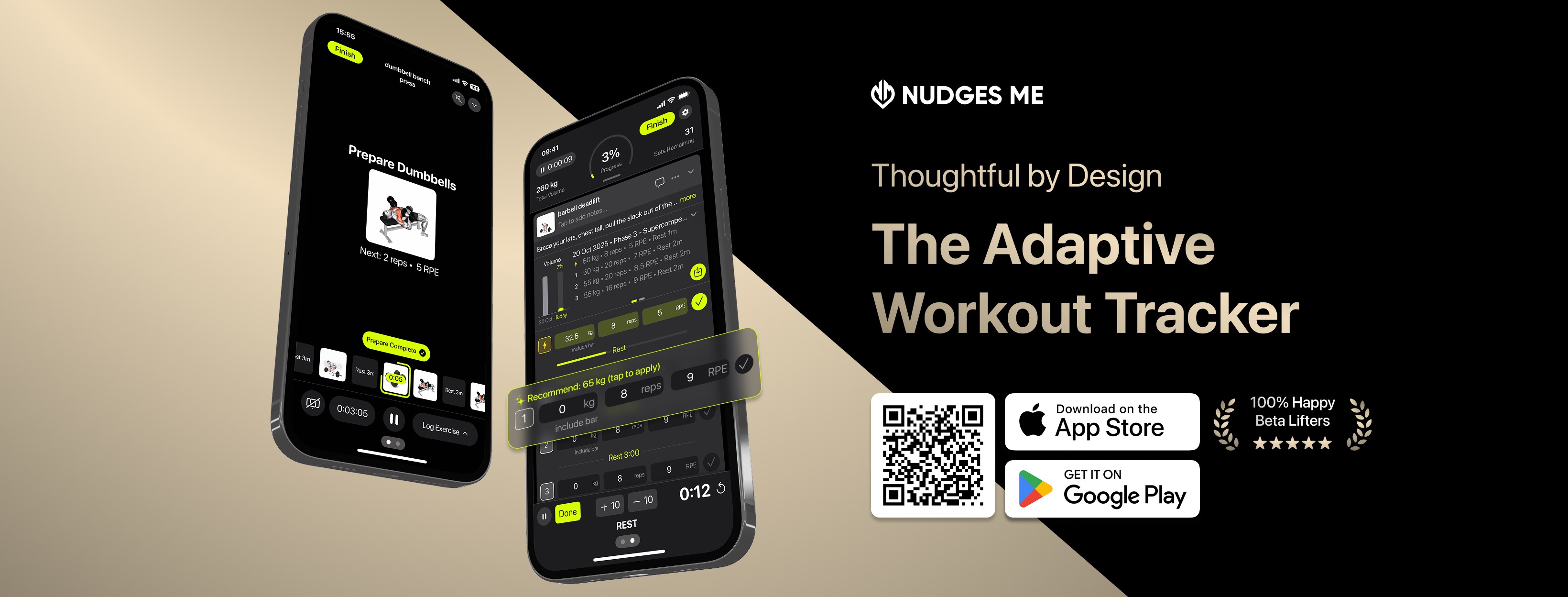
Track this split cleanly with Nudges Me so each workout shows your last performance and your next progression target.
Internal links:
How to progress safely
- Choose 1-2 progression lifts per session.
Example: Bench on chest day, row on back day, squat or leg press on leg day. - Use double progression for most lifts.
Pick a rep range (like 6-10). Add reps until you hit the top end on all sets, then add a small amount of load and repeat. - Keep exercise selection stable for 6-10 weeks.
If you change movements weekly, you cannot see real trends. - Control fatigue with effort targets.
Keep most sets at 1-3 reps in reserve so you can repeat performance next week. - Progress accessories more slowly than compounds.
Compounds drive the trend. Accessories support the trend. - Deload when performance trends down for multiple sessions.
If the numbers and session quality slide for 2-3 exposures, reduce volume for a week, then resume. Use this deload week guide as a simple reference.
Internal links:
Common mistakes
Mistake | Why it’s a problem | Better approach |
|---|---|---|
Picking a bro split with an inconsistent schedule | Missing one day can mean missing a muscle for 2 weeks | Use a more forgiving split or add a “second touch” day |
Too many exercises per session | Quality drops, tracking becomes messy | Keep 4-6 exercises total and repeat them |
Only doing accessories, skipping main lifts | Hard to measure progression and build baseline strength | Start with 1 main lift you can progress |
Going to failure on most sets | Fatigue accumulates fast across 5 days | Leave 1-3 reps in reserve on most sets |
Changing exercises weekly | No stable baseline to improve | Keep key lifts consistent for 6-10 weeks |
Not tracking sets, reps, load | You rely on memory and guess progression | Log every workout so progression is objective |
How to track this with Nudges Me
A bro split only works long term if you can see what is happening over weeks.
With Nudges Me you can:
- Log workouts (exercises, sets, reps, load)
- Follow workout plans so the split stays consistent week to week
- See progression over time by comparing performance across repeated sessions
If you are still deciding between split types, revisit the broader workout split guide and choose the plan you can run consistently.
Stop guessing and stop rebuilding your routine in Notes or spreadsheets. Track your bro split in Nudges Me, follow the plan, and make progression over time obvious.
FAQs
- What is a bro split?
A bro split is a workout split where each training day focuses on one primary muscle group, often across 5 days per week. - Is a bro split good for beginners?
It can work, but many late beginners progress faster with splits that repeat key lifts more often because it reinforces technique and consistency. - How many days per week is a bro split?
Most bro splits are 5 days per week, but some run 4 or 6 days depending on how volume is distributed. - Is a bro split effective for muscle growth?
Yes, it can be effective if weekly training is consistent and you progress sets, reps, or load over time on stable exercises. - What is the biggest downside of a bro split?
Lower frequency per muscle. If you miss a day, you may skip that muscle for an entire week. - How long should I run a bro split before changing it?
Run it for 6-10 weeks before making major changes so you can see real progression trends. - Should I train to failure on a bro split?
Most sets should stay repeatable. Leaving 1-3 reps in reserve on most sets helps recovery across 5 training days. - What should I track on a bro split?
Track exercises, sets, reps, and load. Progress becomes clear when you repeat the same key lifts week to week.

About the author
Trung Do
Related Articles
Continue reading with these related posts

Push Pull Legs Split
Learn the push pull legs split, who it fits, how to run it, and how to progress safely-plus a clean 3-6 day PPL example.
2-Day Workout Split
A complete 2 day workout split guide with examples, progression rules, and tracking tips so you stay consistent and keep getting stronger.

3-Day Workout Split
A 3 day workout split can build strength and muscle with consistent training. Learn the best options, examples, and how to progress safely.

4-Day Workout Split
A 4 day workout split balances training and recovery. See the best 4 day split options, a full example plan, and how to progress safely.

5-Day Workout Split
A practical 5 day workout split guide with examples, progression rules, and tracking tips to stay consistent and keep progressing.

Upper Lower Split
Upper/lower split alternates upper- and lower-body days. Choose 3, 4, or 6 days/week, get a sample routine, and track progression.