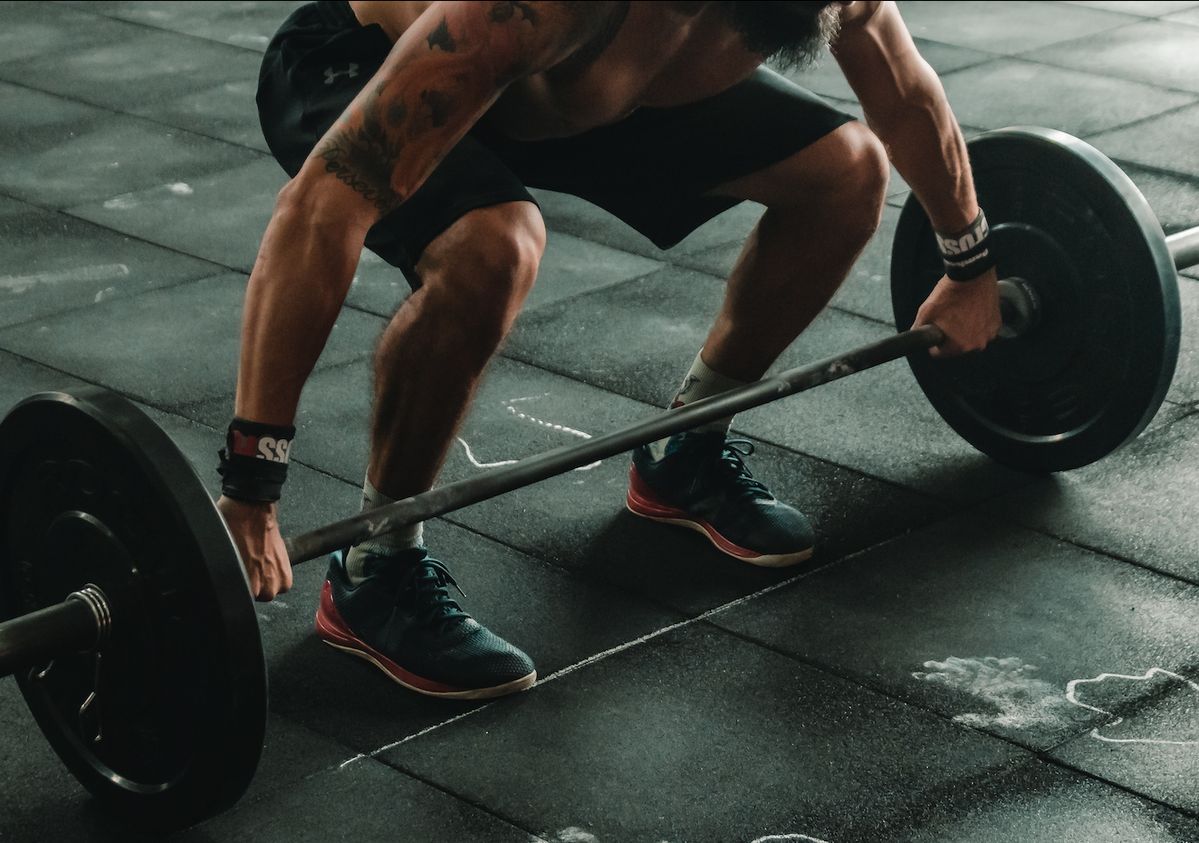
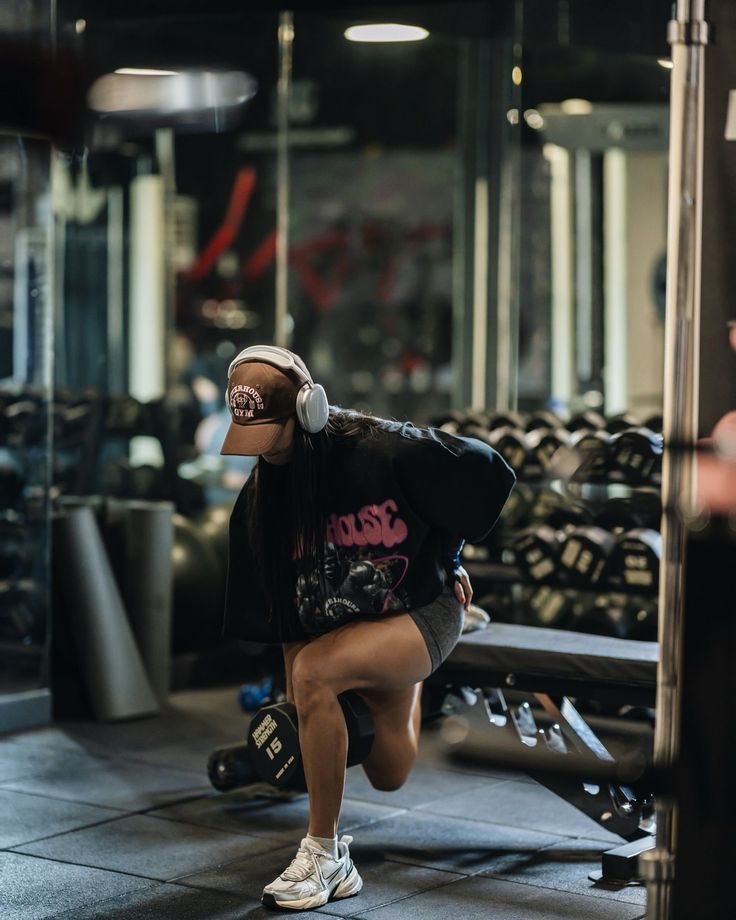
Push Pull Legs Split

Quick Answer / TL;DR
- What it is: A split organized by movement pattern - push, pull, and legs
- Best for: Lifters who like clear day themes and a repeatable weekly rotation
- Not ideal for: People who cannot recover well at higher weekly volume
- Common schedules: 3 days (PPL once) or 5-6 days (repeat cycles)
Push pull legs is a training split that organizes your week into push (chest/shoulders/triceps), pull (back/biceps), and legs so each muscle group gets focused work and enough recovery. It’s best for late beginners through advanced lifters who want a repeatable structure that supports consistency and progression, especially if you’re tired of scattered workouts or tracking in messy notes. Run it well, track performance, and you’ll know exactly what to repeat and improve week to week.
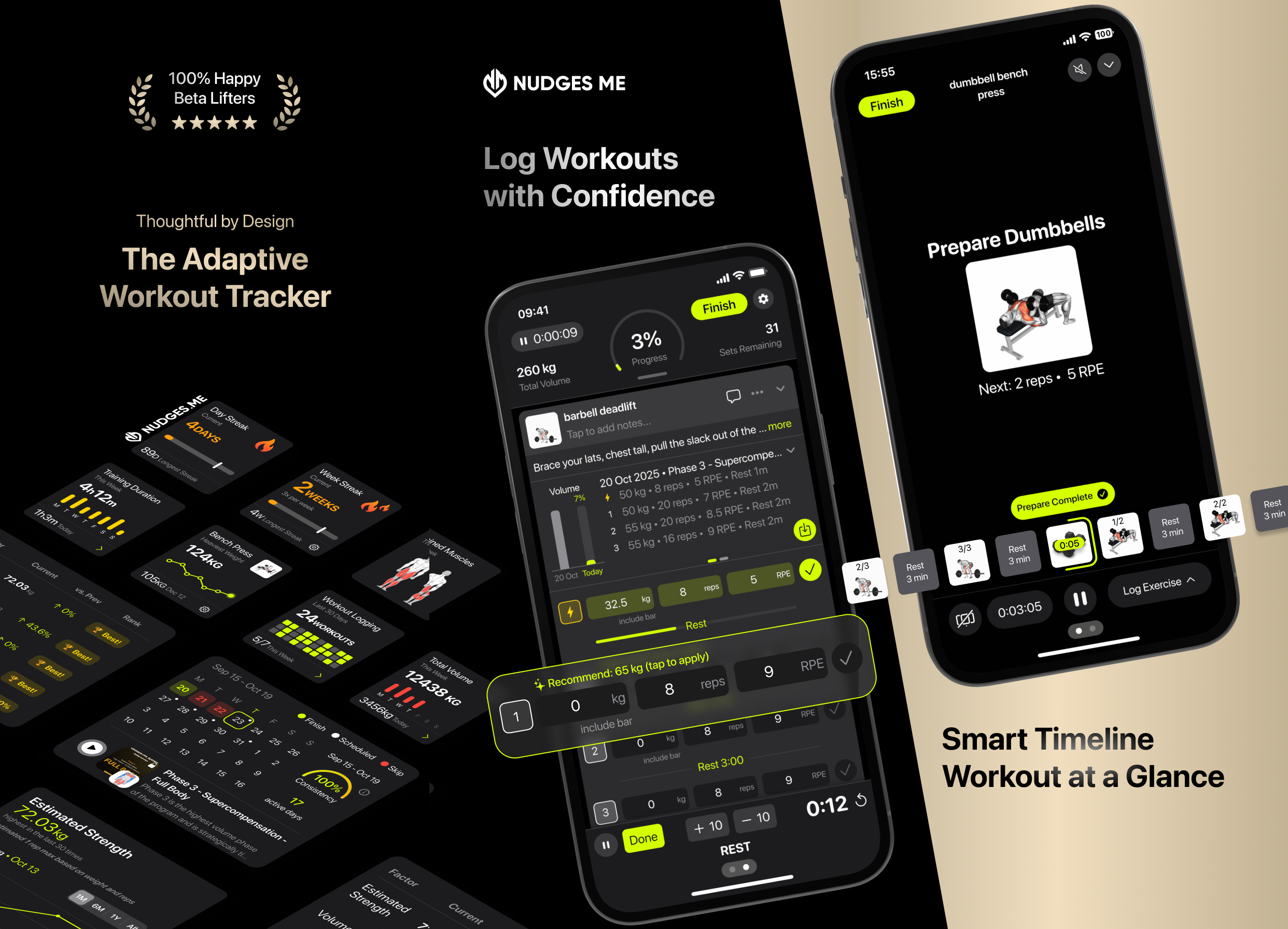
If you want a simple split you can actually stick with, try tracking a PPL week cleanly with Nudges Me App.
What it is and why it works
Push pull legs (PPL) groups exercises by movement pattern:
- Push: pressing and shoulder-dominant work (plus triceps)
- Pull: rowing/pulling and hinge-supporting back work (plus biceps)
- Legs: quads, hamstrings, glutes, calves (and core if you want)
It works because it:
- Simplifies planning: fewer decisions each session.
- Supports recovery: you’re not hammering the same muscles on back-to-back days.
- Makes progression obvious: you repeat similar patterns weekly, so overload is easier to track.
- Scales with frequency: you can run it 3, 4-5, or 6 days/week without reinventing the split.
Best for / Not ideal for
Best for
- Lifters who want a simple weekly structure they can repeat.
- People focused on strength + hypertrophy using compound lifts plus accessories.
- Anyone who needs clarity on “what to train today” and wants to track progression.
- Late beginners ready to move beyond full-body 3x/week into a structured split.
Not ideal for
- True beginners who still need rapid skill practice on the big lifts (full-body may be better).
- Lifters with very limited time who can only train 1-2 days/week.
- Athletes in-season who need sport-specific fatigue management more than volume.
- Anyone trying to cram too many hard sets into one session and repeatedly “misses” recovery.
How it works in practice
A PPL week is built around three training days (push/pull/legs). You choose frequency based on your schedule and recovery:
- 3 days/week: Push → Pull → Legs (each once weekly)
- 4-5 days/week: rotate through Push/Pull/Legs and continue the sequence next week.
- 6 days/week: Push → Pull → Legs → Push → Pull → Legs (each twice weekly).
A typical session includes:
- 1-2 compound lifts (the “progression drivers”)
- 2-4 accessories (to add volume and balance weak links)
- Rep ranges often split into:
- Compounds: ~3-8 reps for strength focus, or ~6-10 for hypertrophy-biased strength
- Accessories: ~8-15+ reps for hypertrophy and joint-friendly volume
A simple rule: push day = press patternspull day = row/pull patterns, legs = knee + hip patterns.
Example routine breakdown
Below are two publish-ready examples: a 3-day PPL (most sustainable starting point) and a 6-day PPL (higher frequency for experienced lifters who recover well).
3-day PPL (repeat weekly)
Day | Focus | Main lifts (progress) | Accessories (build volume) |
|---|---|---|---|
Day 1 | Push | Bench Press (3-5×3-8) Overhead Press (3-4×5-10) | Incline DB Press (2-4×8-12) Lateral Raises (2-4×12-20) Triceps Pressdown (2-4×10-15) |
Day 2 | Pull | Deadlift or RDL (2-5×3-8) Pull-Up or Lat Pulldown (3-5×6-12) | Row Variation (2-4×8-12) Rear Delt Fly (2-4×12-20) Curl Variation (2-4×8-15) |
Day 3 | Legs | Squat (3-5×3-8) Leg Press or Front Squat (2-4×6-12) | Hamstring Curl (2-4×8-15) Calf Raise (2-5×8-15) Optional Core (2-4 sets) |
6-day PPL (higher frequency, lower per-session volume)
Day | Focus | Main lifts (progress) | Accessories (keep it tight) |
|---|---|---|---|
Day 1 | Push A | Bench Press (3-4×3-8) | OHP (2-3×6-10) Lateral Raises (2-3×12-20) Triceps (2-3×10-15) |
Day 2 | Pull A | Row (3-4×6-12) | Pulldown/Pull-Up (2-3×6-12) Rear Delts (2-3×12-20) Curls (2-3×8-15) |
Day 3 | Legs A | Squat (3-4×3-8) | RDL (2-3×6-10) Calves (2-4×8-15) |
Day 4 | Push B | Overhead Press (3-4×5-10) | Incline Press (2-3×8-12) Lateral Raises (2-3×12-20) Triceps (2-3×10-15) |
Day 5 | Pull B | Hinge (RDL/Deadlift variant) (2-4×3-8) | Pulldown/Pull-Up (2-3×6-12) Row (2-3×8-12), Curls (2-3×8-15) |
Day 6 | Legs B | Leg Press/Front Squat (3-4×6-12) | Hamstring Curl (2-4×8-15) Calves (2-4×8-15), Optional Core (2-4 sets) |
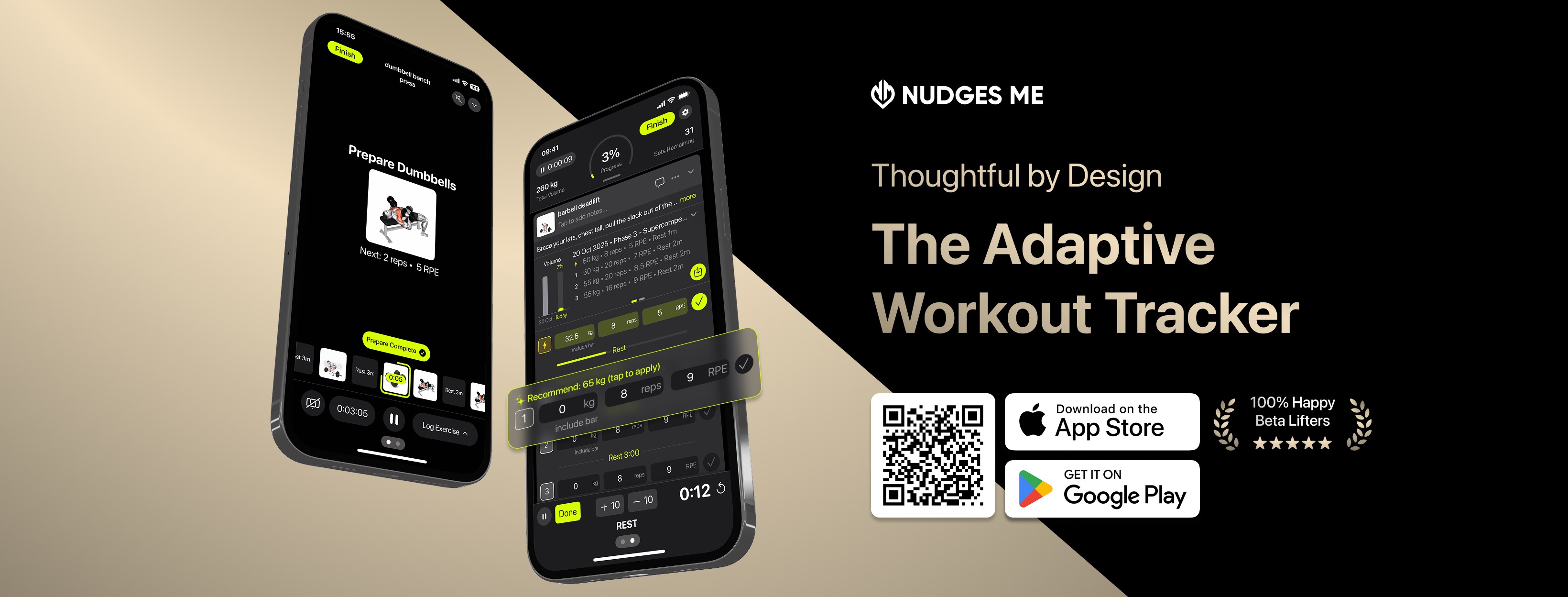
Tips: Follow a PPL plan and log every set in Nudges Me App so your next session starts with the numbers that matter.
How to progress safely
- Pick 1-2 “anchor lifts” per day.
These are the lifts you’ll progress most deliberately (e.g., bench, squat, row, RDL). Keep the variation stable for at least 6-10 weeks. - Use a simple progressive overload rule.
Choose one: - Add reps first: Keep weight the same until you hit the top of the rep range for all sets, then add weight.
- Add load in small steps: Increase 2.5-5 lb when reps and form hold steady.
- Control effort with RPE/RIR.
Most work should live around 1-3 reps in reserve. Save true grinders for occasional test weeks, not every session. - Match volume to recovery.
If your numbers stall and soreness lingers, reduce accessory sets before cutting compounds. PPL works best when you can repeat it consistently. - Track performance over time, not day-to-day emotion.
Your plan is only as good as your ability to see trends: reps, load, and sets completed across weeks.
Common mistakes
Mistake | Why it’s a problem | Better approach |
|---|---|---|
Treating every day like a max-out session | Recovery collapses, technique degrades, progression stalls | Keep most sets at 1-3 RIR; push hard but repeatably |
Too many exercises per session | Fatigue hides progress; sessions become inconsistent | 1-2 compounds + 2-4 accessories is plenty |
Random exercise swaps every week | You can’t track progression on moving targets | Keep main lifts stable for 6-10 weeks |
Pull day becomes “all biceps” | Back volume and quality suffer | Prioritize rows/pulls; add curls after |
Leg day skips hinges or hamstrings | Imbalances, plateaued lower-body strength | Include a hinge pattern (RDL/deadlift variant) and curls |
No written plan for progression | You repeat workouts but don’t improve them | Use rep ranges and a clear rule to add reps/load |
How to track this with Nudges Me App
A PPL split only works long-term if you can repeat the structure and see progression without friction.
With Nudges Me, you can:
- Log workouts fast and consistently (sets, reps, load)
- Follow workout plans so your push/pull/legs days stay organized
- See progression over time by comparing what you did last session/week and progressing deliberately
This is the difference between “I think I’m improving” and “I added 10 lb to my bench for sets of 6 over eight weeks.”
FAQs (5)
- Is push pull legs good for muscle growth?
Yes, PPL makes it easy to get consistent weekly volume and repeat movements so you can progress. - Can beginners do a PPL split?
Late beginners can, especially with a 3-day PPL. True beginners often progress faster on full-body. - Is 3-day PPL enough?
For many lifters, yes. Three high-quality sessions you repeat weekly can drive steady progression. - Should I do deadlifts on pull day or leg day?
Either works. Put them where you can recover best; many prefer pull day to keep leg day more squat-focused. - How long should I run PPL before changing it?
Typically 6-10 weeks per main lift variation, or longer if you’re still adding reps/load consistently.
If your PPL split lives in scattered Notes, notebooks, or spreadsheets, progression gets blurry fast. Replace the mess-track your push/pull/legs plan cleanly in Nudges Me App, log every workout, and watch your progression build week to week.
Still unsure whether this split is right for you? Use our workout splits comparison guide to see how all major splits stack up side by side.
About the author
Trung Do
Related Articles
Continue reading with these related posts