

Deload Week Guide: Recover Without Losing Progress

Quick Answer / TL;DR
A deload week is a planned week where you reduce training stress so fatigue drops and you can keep progressing.
- Best for: Lifters feeling stalled, beat up, or consistently underperforming
- Not ideal for: People who already train inconsistently or are undertraining
- How long: Usually 5-7 days
A deload week is a short period of reduced training stress - usually lower volume and often lower intensity or effort - designed to reduce fatigue and improve readiness for the next training block. It is for late beginner to intermediate and advanced lifters who train consistently, track progression, and want a simple way to keep progressing without running themselves into the ground. Used well, deloads protect consistency and make progressive overload easier to sustain across months, not just good weeks.
If you feel beaten up or stuck, try one deload week and see how different the next week feels when you return to normal training.
Internal links:
What it is and why it works
A deload week is not “doing nothing.” It is a planned reduction in training stress so accumulated fatigue drops while fitness is maintained. In the research and coaching literature, deloading is commonly described as a short phase with reduced volume and intensity aimed at mitigating fatigue and improving training outcomes.
Why it works:
- Fatigue masks fitness. If you train hard for weeks, fatigue builds and performance can stall even if you are getting fitter.
- Planned recovery supports long-term progress. Periodization is the planned manipulation of training variables to maximize adaptation and reduce the risk of overtraining. Deloads fit that logic as a recovery-focused microcycle.
- It improves your ability to “reload” and push again. Deloads are often differentiated from tapering because the goal is not peak performance for an event - it is preparedness for the next block.
Internal links:
Best for / Not ideal for
Best for
- Lifters running 4-10 week training blocks and pushing progression
- People seeing performance flatten despite consistent effort
- Lifters feeling joint irritation, poor sleep, or “heavy” sessions week after week
- Anyone who wants to stay consistent without forcing grind sessions year-round
Not ideal for
- People who already train inconsistently (you may need a simpler plan first)
- Lifters who are undertraining (low volume, low effort, no progression targets)
- Anyone who interprets deload as a full week off by default (sometimes needed, but not the default)
- People who change exercises every week and cannot tell what is fatigue vs programming noise
Internal links:
How it works in practice
Most deloads reduce training stress by changing one or more of these:
- Volume: fewer reps per set, fewer sets per session, or both
- Intensity (load): lower percentages of 1RM
- Intensity of effort: stop sets farther from failure by increasing reps in reserve
- Exercise selection (sometimes): keep the same lifts to stay specific, or swap in less stressful variations if joints need a break
How often?
- Many coaches place deloads at the end of a mesocycle, commonly around every 4-6 weeks for about 7 days, with flexibility depending on the lifter and training phase.
What usually stays the same?
- In survey data from strength and physique athletes, deloads commonly reduce volume and also reduce load and effort, while training frequency often stays unchanged and exercise selection is usually maintained.
Internal links:
Example (deload week template)
This is one simple way to deload without overthinking it: keep your usual schedule, keep the same main lifts, cut stress by reducing volume and keeping more reps in reserve. This matches common deload approaches described in the literature (volume down, effort down, sometimes load down).
What you normally do | Deload week adjustment | What it accomplishes |
|---|---|---|
Primary compound lift: 4 hard sets | Do 2-3 sets, stop with 3-4 reps in reserve | Big fatigue drop, practice stays sharp |
Secondary compound: 3-4 sets | Do 2 sets, keep reps smooth | Maintain pattern, reduce workload |
Accessories: 3-4 movements | Keep 1-2 movements, 1-2 sets each | Keep blood flow, remove “extra” fatigue |
Supersets, intensity techniques | Remove them for the week | Lowers density and local fatigue |
Example for a 4-day split (one session shown):
Section | Exercise | Normal week | Deload week |
|---|---|---|---|
Main lift | Bench press | 4 x 5-6, hard | 2-3 x 5, leave 3-4 reps in reserve |
Secondary | Row | 4 x 8-10 | 2 x 8, leave 3 reps in reserve |
Accessory | Incline DB press | 3 x 10-12 | 1-2 x 10, easy |
Accessory | Lateral raise | 3 x 12-20 | 1 x 12-15, easy |
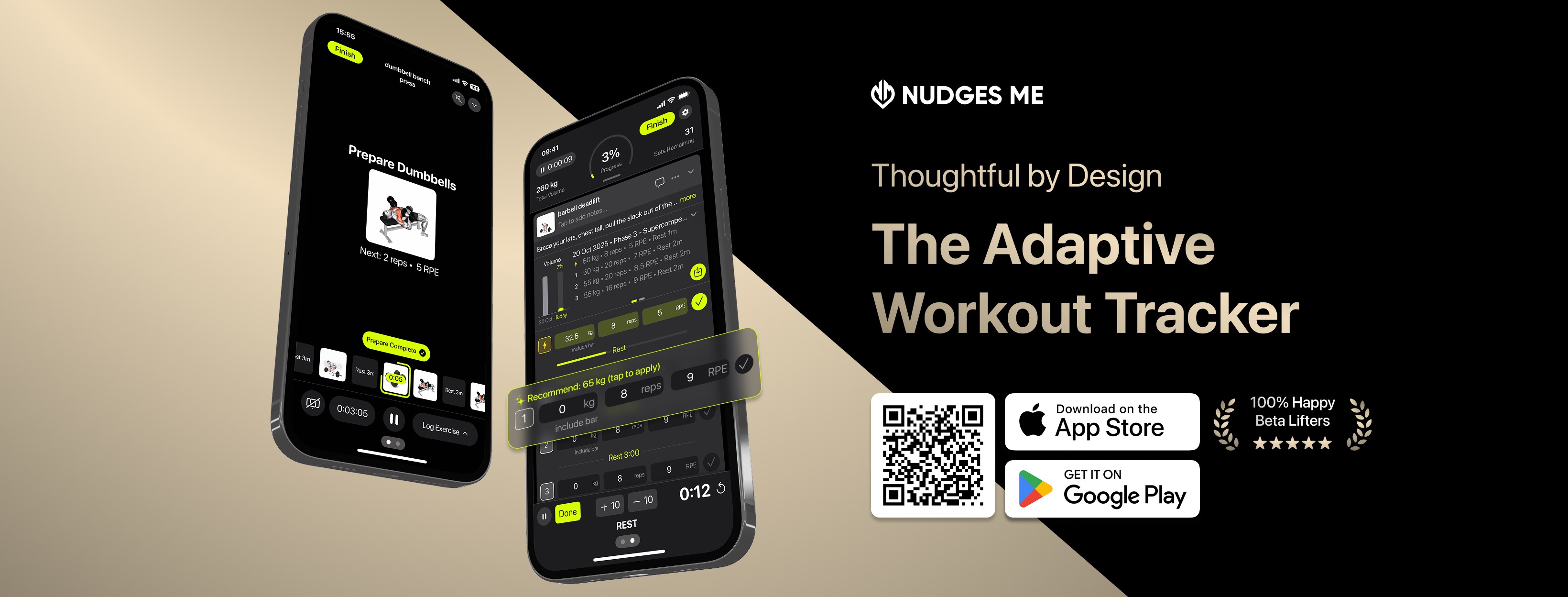
Track your deload week cleanly with Nudges Me so you can compare your next block against your real baseline, not a tired version of you.
Internal links:
How to progress safely
- Deload based on trend, not panic.
If performance stalls for multiple exposures to the same lift and fatigue feels high, a deload is often more productive than forcing harder sessions. Deloads are commonly integrated after harder microcycles or at the end of a block. - Reduce volume first.
There is broad agreement that volume should decrease during deloading, most commonly by reducing reps, sets, or both. - Keep effort clearly submaximal.
Stop sets farther from failure for the week by increasing reps in reserve. This reduces fatigue while keeping movement practice. - Do not “test” your max on deload week.
A deload is to restore readiness, not to prove strength. - Return to progressive overload with a plan.
After the deload, resume your progression rule (add reps, then load, or similar). Progressive overload and deloading work together: overload creates the stimulus, deloading helps you sustain it. - Track performance over time to time deloads better.
When you can see weeks of training, you can spot patterns: when you tend to stall, how quickly you rebound, and what deload style works best.
Internal links:
Common mistakes
Mistake | Why it’s a problem | Better approach |
|---|---|---|
Taking a full week off by default | You may lose rhythm and re-entry feels harder than needed | Start with reduced training stress first, take full rest only when truly needed |
Keeping volume the same but “going lighter” | Fatigue may stay high if the workload is still large | Reduce sets and total work as the main lever |
Turning deload week into a max-out week | It defeats the point and can extend fatigue | Keep effort clearly submaximal, leave reps in reserve |
Changing every exercise at once | You lose continuity and cannot compare performance | Keep main lifts consistent, adjust accessories if joints need relief |
Deloading too late, after burnout | Recovery takes longer and progress resets | Plan deloads into training blocks before fatigue becomes a wall |
How to track this with Nudges Me
A deload only helps if it supports long-term progression.
With Nudges Me, you can:
- Log workouts so your deload week is recorded instead of forgotten
- Follow workout plans so you return to the same structure after the deload
- See progression over time by comparing performance before and after deload weeks
FAQs
- What is a deload week?
A short week where training stress is reduced to lower fatigue and improve readiness for the next block. - Will I lose muscle or strength during a deload?
A deload is designed to reduce fatigue while maintaining training exposure, so most lifters do not lose meaningful progress in one week. - How often should I deload?
Many coaches commonly place deloads at the end of a block, often around every 4-6 weeks, but it depends on your fatigue and training phase. - Should I keep the same exercises during a deload?
Often yes, especially for main lifts. Many lifters maintain exercise selection while reducing volume, load, and effort. - Is a deload the same as a taper?
Not exactly. A taper is usually used to peak for performance, while deloading is used to restore readiness for the next training cycle.
Stop guessing when to back off. Replace messy notes and spreadsheets with Nudges Me, follow your plan, log every session, and make deloads part of a progression system you can actually sustain.
About the author
Trung Do
Related Articles
Continue reading with these related posts

RPE/RIR for consistent training
Learn the RPE scale and RIR for lifting. Use RPE to stay consistent, manage effort, and progress week to week without guessing.
Progressive Overload Explained: Gain Muscle & Strength
Learn progressive overload, how to apply it safely, and how to track progression so you keep getting stronger week to week.