
RPE/RIR for consistent training

Quick Answer / TL;DR
- RPE meaning: How hard a set feels on a 1-10 effort scale
- RIR meaning: How many reps you had left in the tank
- Best for: Lifters who want consistent effort across weeks and cleaner progression tracking
- Not ideal for: People who guess effort without repeating lifts or tracking results
- Use it for: Keeping most sets repeatable, not maxing out every session
RPE is a rating of perceived exertion that tells you how hard a set felt based on how many reps you had left in the tank. It is for lifters who want a simple way to control effort, stay consistent across weeks, and keep progression moving without turning every session into a max-out. When you pair RPE with clean tracking, you can repeat training with the right intensity and apply progressive overload more reliably.
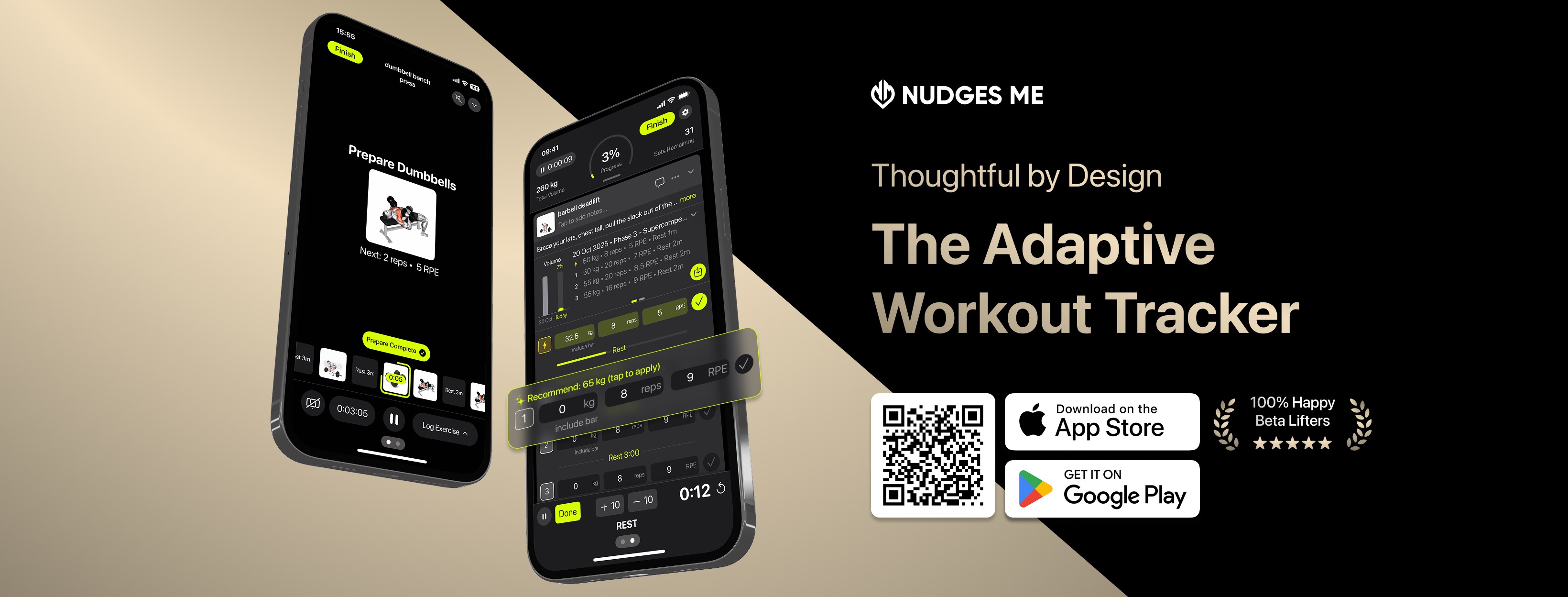
Want to see how consistent your effort really is? Try logging a week of RPE with Nudges Me and compare how your sets feel across sessions.
What it is and why it works
RPE stands for Rate of Perceived Exertion. In the gym, lifters use RPE to estimate how close a set was to failure.
RIR stands for Reps In Reserve. It is the flip side of the same idea - how many reps you could have done before you failed.
- RIR is a count: 2 RIR means you had about 2 reps left.
- RPE is a rating: higher number means closer to failure.
This works because it helps you:
- Standardize effort when sleep, stress, and energy vary
- Avoid accidental sandbagging (too easy) and accidental grinders (too hard)
- Progress more predictably by keeping hard sets hard, but repeatable
Best for / Not ideal for
Best for
- Lifters who want consistent hard sets without guessing daily loads
- People running structured plans who need repeatable effort week to week
- Late beginners moving into intermediate training where load jumps slow down
- Anyone who tends to overshoot and burn out or undershoot and stall
Not ideal for
- True beginners who cannot yet judge proximity to failure reliably
- Very technical lifts in novices where form breakdown confuses effort rating
- People who change exercises constantly and cannot build consistent feel
- Anyone using RPE as an excuse to avoid adding load or reps over time
How it works in practice
RPE and RIR conversion
Most lifters use a simple mapping:
- RPE 10 = 0 RIR (max effort, no reps left)
- RPE 9 = 1 RIR
- RPE 8 = 2 RIR
- RPE 7 = 3 RIR
- RPE 6 = 4 RIR
This is not perfect math. It is an estimate. The goal is consistency, not perfection.
How to use it in real training
Use RPE or RIR for your main working sets, especially on big compound lifts.
Common prescriptions look like:
- 3 sets of 5 at RPE 8
- Top set at RPE 8, then 2 back-off sets at RPE 7
- 4 sets of 8 with 2 RIR
Practical rules that keep it simple:
- If the set moved fast and you could do 4+ more reps, it was too easy for a hard set.
- If you had to grind, lose position, or slow dramatically, it was too hard for repeatable progression.
- Most productive training lives around RPE 7 to 9 for working sets, depending on the lift and phase.
Example framework and RPE chart
Simple RPE chart for gym training
RPE | Approx. RIR | What it feels like | Best use |
|---|---|---|---|
6 | 4 | Easy, crisp reps | Technique, warm-ups, light volume |
7 | 3 | Solid work, no grind | Volume work, repeatable sets |
8 | 2 | Hard but clean | Most working sets for progress |
9 | 1 | Very hard, near limit | Occasional top sets, testing readiness |
10 | 0 | Max effort | Rare, not for frequent training |
Example: Bench press day using RPE
Exercise | Sets x Reps | Target effort | Notes |
|---|---|---|---|
Bench Press | 1 x 5 | RPE 8 | Top set, leave 2 reps in reserve |
Bench Press | 2 x 5 | RPE 7 | Back-off sets, same reps, slightly easier |
Incline DB Press | 3 x 8-12 | 2 RIR | Stop with clean form |
Row Variation | 3 x 8-12 | 2 RIR | Balance pressing volume |
Triceps Pressdown | 2-3 x 10-15 | 2-3 RIR | Pump work, no elbow flare |
If you want this to work long-term, track your loads, reps, and RPE in one place. Log the session in Nudges Me and repeat it next week with a clear target.
How to progress safely
- Pick a target RPE or RIR range for your main lift.
Example: sets of 5 at RPE 7-8 for a volume phase. - Progress with one variable at a time.
Use progressive overload without chaos: - Add 1 rep per set while holding RPE constant, then add load.
- Or add 2.5-5 lb while keeping reps and RPE consistent.
- Use RPE to adjust on low-readiness days, not to avoid progression.
If the weight that was RPE 8 last week is RPE 9 today, reduce load slightly and hit the target effort. You still completed the plan. - Keep most hard work repeatable.
Frequent RPE 10 sets can stall progress and increase fatigue. Save them for rare tests. - Track performance over time.
You should be able to look back and answer: - Did my load increase at the same RPE?
- Did I get more reps at the same RPE?
- Did I maintain effort while improving technique?
Common mistakes
Mistake | Why it’s a problem | Better approach |
|---|---|---|
Rating RPE based on pain or discomfort | Discomfort is not the same as proximity to failure | Rate effort by reps left and bar speed, keep technique strict |
Turning every set into RPE 9-10 | Too much fatigue, inconsistent performance, stalled progression | Keep most work in RPE 7-8, use RPE 9 sparingly |
Using RPE without tracking load and reps | RPE alone cannot show progression | Track load, reps, sets, and RPE together |
Changing exercises weekly | Your RPE sense resets each time, progress becomes unclear | Keep main lifts stable 6-10 weeks |
Confusing RPE with percentages | Percent-based training and RPE serve different purposes | Use RPE to guide effort, use progression rules to drive improvement |
Guessing RPE before the set | You only know RPE after the set is done | Perform the set, then rate it honestly |
How to track this with Nudges Me
RPE and RIR only help if you can repeat sessions and see what changed.
With Nudges Me, you can:
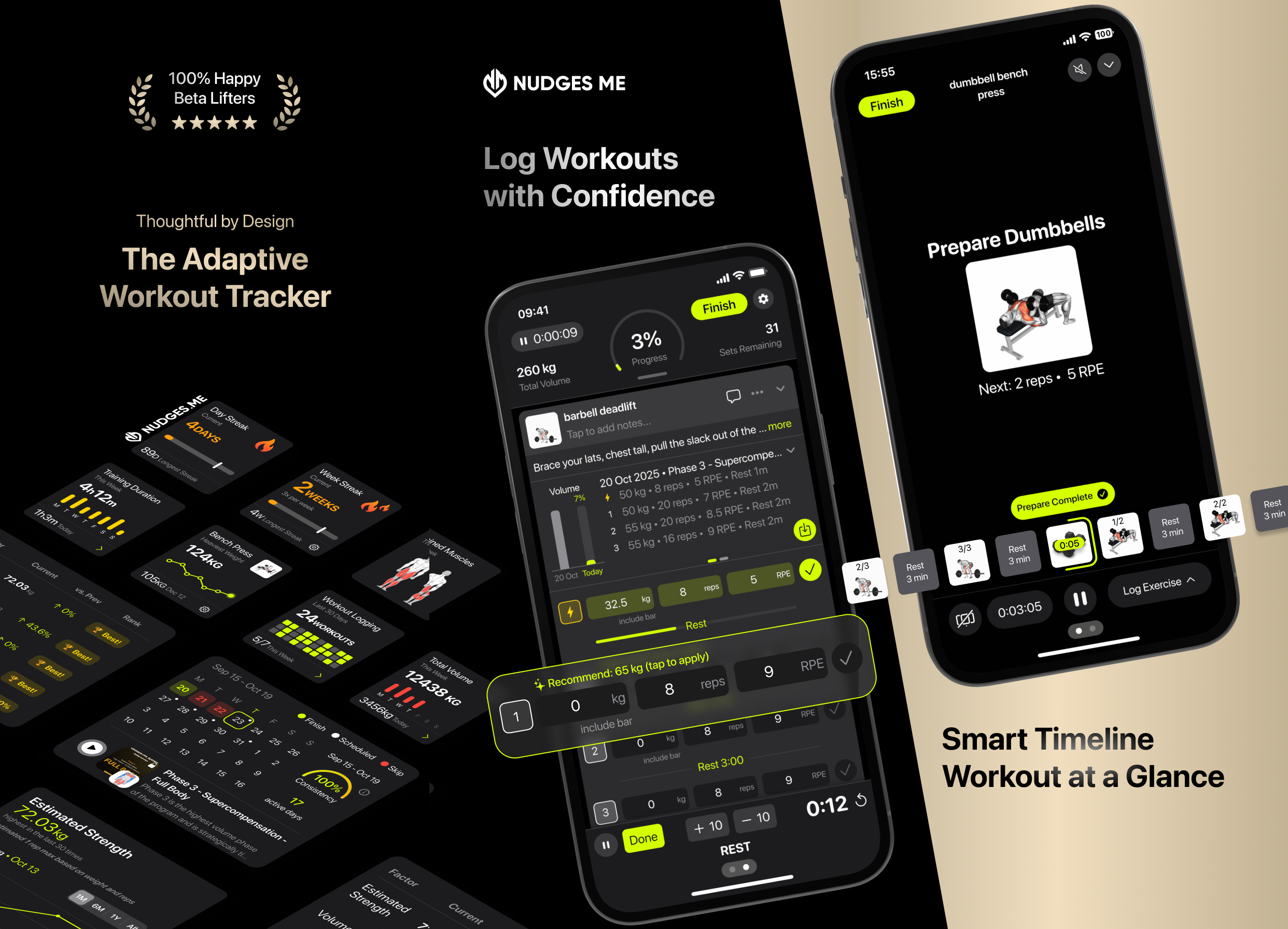
- Log workouts with sets, reps, load, and your RPE notes
- Follow workout plans that prescribe target RPE or RIR for key lifts
- See progression over time by comparing last week’s numbers to this week’s effort
This is the core loop: repeat the plan, hit the target effort, and progress when the same RPE becomes easier.
FAQs (5)
- What is RPE in the gym?
RPE is a 1-10 effort rating that estimates how close you were to failure on a set. - What is RIR and how is it different from RPE?
RIR is the number of reps you had left. RPE is a rating that corresponds to that estimate. - What RPE should I train at for muscle and strength?
Most productive working sets are often around RPE 7-9, depending on the lift and program. - Is an RPE chart accurate?
It is an estimate. It becomes useful when you apply it consistently and track results. - Should I use RPE for every exercise?
Start with main lifts and big accessories. For small isolation work, simple RIR targets are often enough.
If your RPE notes are scattered across a notebook, Notes app, or spreadsheets, you lose the whole point - repeatability. Log your sets, reps, load, and RPE in Nudges Me App, follow your plan, and make progression obvious week to week.
About the author
Trung Do
Related Articles
Continue reading with these related posts