

5-Day Workout Split

Quick Answer / TL;DR
A 5-day workout split spreads training across five sessions per week so you can distribute volume, repeat key lifts, and progress without cramming everything into fewer days.
- Best for: Intermediates with reliable schedules and solid recovery
- Not ideal for: Anyone who turns every day into max effort or cannot sleep and recover well
- How long to run: 6-10 weeks with stable exercise selection
A 5 day workout split is a weekly training plan where you lift five days per week, using a structured schedule to spread training volume and repeat key lifts for progression. It is best for late beginner to intermediate and advanced lifters who can train consistently, recover well, and want a simple system to drive progression over time. The goal is not to “do more” randomly - it is to apply progressive overload, track performance cleanly, and keep improving week after week.
If you have been training consistently but your sessions feel scattered, run one 5 day split for 6 weeks and track just a handful of main lifts - the pattern becomes obvious fast.
Internal links:
What it is and why it works
A 5 day split works when it does three things well:
- Distributes weekly training volume. Higher weekly volume is strongly associated with greater hypertrophy up to a point, and five sessions can make that volume easier to recover from than cramming it into fewer days.
- Keeps exercise selection stable enough to measure progress. Progress requires repeat exposures to the same lifts so you can add reps, load, or sets with intent.
- Matches training frequency to experience and recovery. ACSM progression guidance commonly places advanced lifters at higher weekly training frequencies than novices.
A useful way to think about it: frequency is the schedule, volume is the work. For muscle growth, evidence suggests frequency matters less when weekly volume is matched, but higher frequency can help you fit volume in without wrecking recovery.
Internal links:
Best for / Not ideal for
Best for
- Lifters who can reliably train 5 days per week
- Late beginner to intermediate lifters who want more practice on key lifts
- Advanced lifters who need more weekly volume to keep progressing
- Anyone who wants a clean plan instead of improvising daily
Not ideal for
- Anyone who cannot recover well at 5 days (sleep, stress, schedule)
- Lifters who tend to “max out” often and accumulate fatigue quickly
- People who constantly swap exercises (progress becomes hard to track)
- Lifters who only have 30 minutes and rush through every session (better to use a simpler split)
Internal links:
How it works in practice
A 5 day split usually falls into one of two buckets:
1) Higher frequency per muscle (often 2 times per week)
These splits hit most muscle groups at least twice weekly by repeating patterns (push, pull, legs) and adding upper or lower days.
Why many lifters prefer it:
- You practice the main lifts more often.
- You can spread weekly sets across more sessions.
- It is easier to keep set quality high when you are not doing everything in one day.
This approach aligns with common guidance that advanced lifters may train 4-6 days per week while training each major muscle group about once to twice per week.
2) Body part split (often 1 time per week per muscle)
The classic “chest day, back day” setup. It can work, especially if you are accumulating enough weekly volume, but it is easier to lose continuity and harder to adjust when a session goes poorly.
Evidence nuance:
- When weekly volume is equated, hypertrophy differences between training frequencies are small in the research.
- In real training, a 5 day schedule often makes it easier to achieve and sustain the weekly volume you need.
Internal links:
Example (routine / framework / breakdown)
Below are two practical 5 day options. Pick the one you can repeat consistently for 6-10 weeks.
Example A - PPL + Upper + Lower (balanced, repeatable)
Day | Focus | Main lift(s) | Secondary work |
|---|---|---|---|
Day 1 | Push | Bench press + overhead press | Chest, shoulders, triceps accessories |
Day 2 | Pull | Row + pull-up or pulldown | Rear delts, biceps, upper back accessories |
Day 3 | Legs | Squat pattern | Hamstrings, calves, single-leg work |
Day 4 | Upper | Bench or incline + row | One press, one pull, arms optional |
Day 5 | Lower | Hinge pattern (deadlift or RDL) | Quad accessory, hamstrings, core |
Days 6-7 | Rest | - | Light activity optional |
Example B - Body part split (simple, but lower frequency per muscle)
Day | Focus | Main lift(s) | Secondary work |
|---|---|---|---|
Day 1 | Chest | Bench press | Incline, fly variation |
Day 2 | Back | Row + pulldown | Upper back, rear delts |
Day 3 | Legs | Squat pattern | Hinge accessory, calves |
Day 4 | Shoulders | Overhead press | Lateral raise, rear delts |
Day 5 | Arms | Curl + triceps pressdown | Extra biceps and triceps work |
Days 6-7 | Rest | - | Light activity optional |
Simple set and rep targets you can apply to either split:
- Main compounds: 3-5 sets of 3-8 reps
- Secondary compounds: 2-4 sets of 6-12 reps
- Accessories: 1-3 sets of 10-20 reps
- Most working sets: stop with 1-3 reps in reserve (repeatable effort)
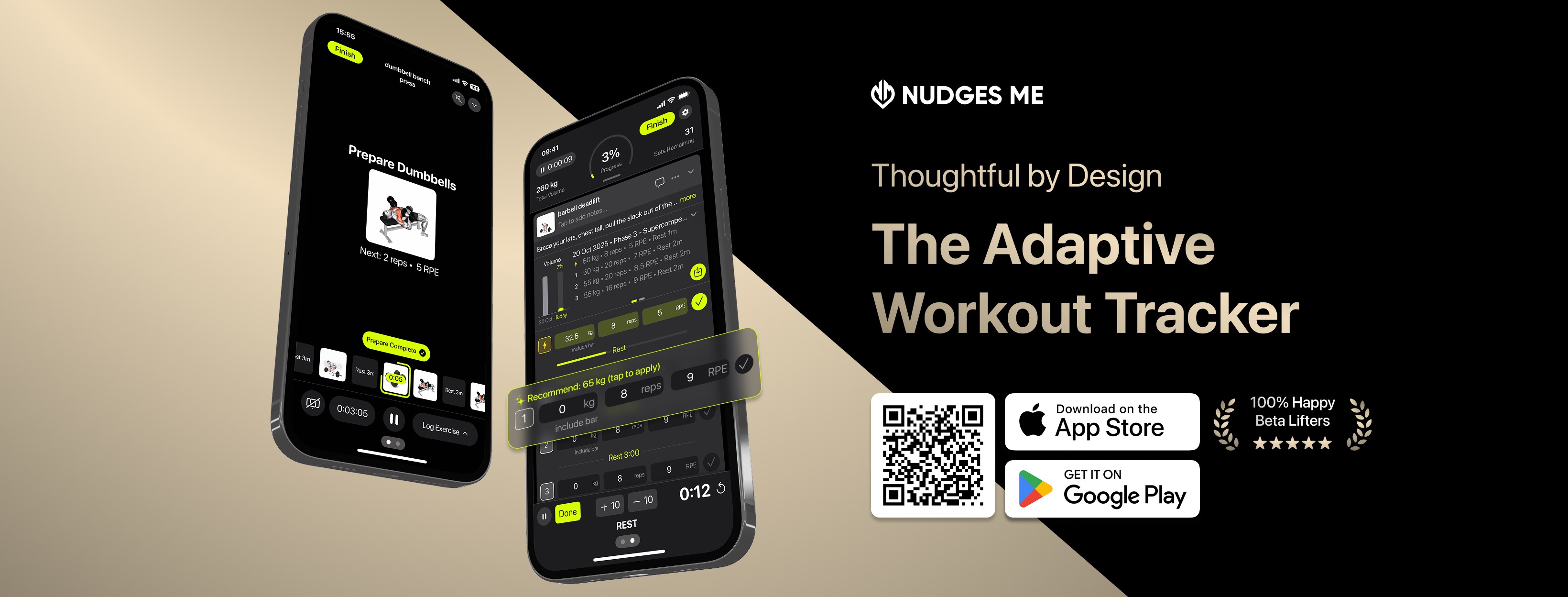
Track this split cleanly with Nudges Me so every session shows you what you did last time and what to beat next time.
Internal links:
How to progress safely
- Run the same split long enough to learn it.
Commit to 6-10 weeks before making big changes. Consistency is what makes progression measurable. - Choose 1-2 “progression lifts” per day.
These are the lifts you track most closely and aim to improve weekly. - Use a simple progression rule.
Double progression works well: pick a rep range, add reps until you hit the top end for all sets, then add a small amount of load and repeat. - Increase weekly volume gradually.
More volume can drive hypertrophy, but big jumps can outpace recovery. Add sets slowly and only when performance is stable. - Plan recovery before you need it.
If performance trends down across multiple sessions, reduce training stress for a week (a deload) and then resume progression. - Track performance over time, not just effort.
Progressive overload is a long-term trend. Your log should show gradual improvements across weeks.
Internal links:
Common mistakes
Mistake | Why it’s a problem | Better approach |
|---|---|---|
Turning 5 days into 5 max-effort days | Fatigue accumulates and progression stalls | Keep most sets repeatable, save all-out efforts for rare tests |
Adding more exercises instead of progressing lifts | Workouts get longer but results do not improve | Progress a few main lifts first, then earn extra volume |
Hitting some muscles once a week with low volume | Not enough weekly stimulus for many lifters | Either increase weekly sets or use a higher-frequency split |
Changing the plan every week | You cannot compare performance cleanly | Keep key lifts stable for a full block |
Skipping lower body or pulling volume | Imbalances and plateau risk | Train squat, hinge, press, pull each week |
Not tracking sessions consistently | You guess at progression | Log sets, reps, and load every workout |
How to track this with Nudges Me
A 5 day split only works if you can see what you are actually doing.
With Nudges Me, you can:
- Log workouts (exercises, sets, reps, load)
- Follow workout plans so your split stays consistent week to week
- See progression over time by comparing performance across sessions and weeks
FAQs
- Is a 5 day workout split too much?
It depends on recovery and how hard you train each day. Many lifters do well if volume and effort are managed. - Should I train each muscle once or twice per week on a 5 day split?
If weekly volume is matched, frequency matters less for hypertrophy, but many lifters find twice weekly easier for quality work and consistency. - What is the best 5 day split for strength?
A split that repeats the main lifts and allows consistent progression, often with 1-2 primary compound lifts per session. - How long should I run a 5 day split before changing it?
Usually 6-10 weeks, long enough to see clear progression trends. - What if I miss one day in a 5 day split?
Do the next planned session when you can. Do not cram two full workouts into one day.
Stop guessing what you did last week. Replace messy notes and spreadsheets with Nudges Me, follow your 5 day plan, log every workout, and make progression over time easy to see and easier to stick to.
Still unsure whether a 5 day split is right for you? Use our workout splits comparison guide to see how all major splits stack up side by side.

About the author
Trung Do
Related Articles
Continue reading with these related posts

2-Day Workout Split
A complete 2 day workout split guide with examples, progression rules, and tracking tips so you stay consistent and keep getting stronger.

3-Day Workout Split
A 3 day workout split can build strength and muscle with consistent training. Learn the best options, examples, and how to progress safely.

4-Day Workout Split
A 4 day workout split balances training and recovery. See the best 4 day split options, a full example plan, and how to progress safely.