

3-Day Workout Split

Quick Answer / TL;DR
A 3-day workout split is typically a full-body structure that trains three times per week, giving most lifters enough frequency to progress while keeping recovery manageable.
- Best for: Late beginners to intermediates who want consistency without complexity
- Not ideal for: Lifters who want high weekly volume or advanced specialization
- How long to run: 6-10 weeks with the same core lifts
If you’re still deciding which workout split fits your schedule and experience, start with our complete workout split guide.
A 3 day workout split is a weekly training plan that organizes your workouts into three repeatable sessions so you can train consistently and progress over time. It is for lifters who want real results with a schedule they can sustain, especially late beginners to intermediate lifters who are tired of guessing or tracking in messy notes and spreadsheets. When you repeat the same structure and track performance, progression becomes clear and progressive overload becomes easier to apply.
If you want a plan you can actually stick to, run a 3 day split for four weeks and track every session so you can see what is improving.
What it is and why it works
Three days per week is enough to build serious strength and muscle because it balances:
- Training stimulus: enough hard work to drive adaptation
- Recovery: enough rest days to show up strong again
- Consistency: realistic scheduling for most adults
A good 3 day split works when it:
- Repeats key movement patterns weekly
- Uses a small set of core lifts you can progress
- Keeps volume per session high enough to matter, but not so high you cannot recover
If you want the “best” routine, start with the one you can repeat for months, not the one that looks hardest on paper.
Best for / Not ideal for
Best for
- Lifters training around work, school, or family who need a realistic schedule
- Late beginners building momentum with a structured routine
- Intermediate lifters who want a sustainable baseline plan
- People who want fewer workout days but still want progression
Not ideal for
- Lifters who truly can only train 1-2 days per week
- Advanced lifters chasing very high specialization or high weekly volume for one lift
- People who change exercises every session and cannot repeat a plan
- Anyone who turns each workout into a marathon and misses sessions after
How it works in practice
There are three practical ways to build a 3 day split. The best choice depends on how experienced you are and what you want to improve.
Option 1: Full body (3x/week)
- You train the whole body each day with a few big movements.
- Great for late beginners and anyone who wants simple progression.
Option 2: Upper lower full body
- Day 1: upper emphasis
- Day 2: lower emphasis
- Day 3: full body or weak point emphasis
- Great for late beginner to intermediate lifters.
Option 3: Push pull legs (3x/week)
- Day 1 push, Day 2 pull, Day 3 legs
- Great when you want clear focus per day, but still only train three days.
The common thread is not the split name. It is the repeatability of the plan and your ability to progress your main lifts over time.
Example split routines
Below are three ready-to-run examples. Pick one and run it for at least 4-8 weeks.
Example A: Full body 3 day split
Day | Main lifts | Accessories |
|---|---|---|
Day 1 | Squat 3-5 x 3-8 Bench 3-5 x 3-8 | Row 2-4 x 8-12 Split squat 2-3 x 8-12 |
Day 2 | Deadlift or RDL 2-5 x 3-8 Overhead Press 3-5 x 5-10 | Pull-up or Pulldown 2-4 x 6-12 Ham curl 2-3 x 8-15 |
Day 3 | Front squat or Leg press 3-5 x 6-12 Incline press 3-5 x 6-12 | Row 2-4 x 8-12 Lateral raise 2-4 x 12-20 Calf raise 2-4 x 8-15 |
Example B: Upper, lower, full body
Day | Focus | Main lifts | Accessories |
|---|---|---|---|
Day 1 | Upper | Bench 3-5 x 3-8 Row 3-5 x 6-12 | Incline DB 2-4 x 8-12 Lateral raise 2-4 x 12-20 Triceps 2-3 x 10-15 |
Day 2 | Lower | Squat 3-5 x 3-8 RDL 3-4 x 6-10 | Leg press 2-4 x 10-15 Ham curl 2-4 x 8-15 Calves 2-4 x 8-15 |
Day 3 | Full body | Pull-up or Pulldown 3-5 x 6-12 Overhead press 3-5 x 5-10 | Split squat 2-3 x 8-12 Row 2-4 x 8-12 Curls 2-3 x 8-15 |
Example C: Push pull legs (3 days)
Day | Focus | Main lifts | Accessories |
|---|---|---|---|
Day 1 | Push | Bench 3-5 x 3-8 Overhead press 3-4 x 5-10 | Incline press 2-4 x 8-12 Lateral raise 2-4 x 12-20 Triceps 2-4 x 10-15 |
Day 2 | Pull | Row 3-5 x 6-12 Pulldown 3-5 x 6-12 | Rear delts 2-4 x 12-20 Curls 2-4 x 8-15 Optional hinge 2-3 x 6-10 |
Day 3 | Legs | Squat 3-5 x 3-8 Leg press 2-4 x 10-15 | Ham curl 2-4 x 8-15 Calves 2-5 x 8-15 Optional core 2-4 sets |
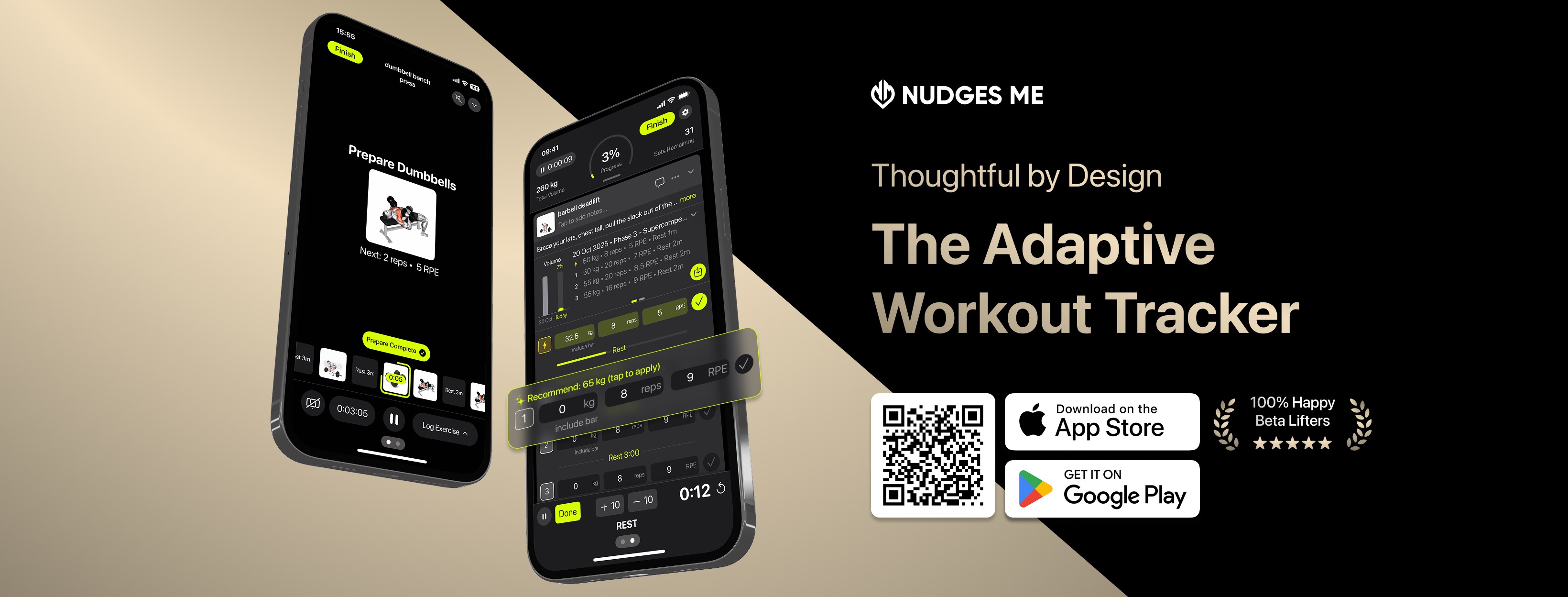
Pick one of these 3 day splits and track it for 4-8 weeks in Nudges Me. When the plan stays stable, progression becomes obvious.
How to progress safely
- Choose rep ranges and keep them stable.
Example: squat 3-8, bench 3-8, row 6-12, accessories 8-15. - Progress one variable at a time.
Use progressive overload: - Add reps first until you hit the top of the range, then add load.
- Or add small load jumps while keeping reps and form consistent.
- Use an effort guardrail.
Most working sets should feel hard but repeatable, like 1-3 reps in reserve. This keeps fatigue manageable on a 3 day schedule. - Add volume only after you earn it.
If you are progressing, do not add more exercises. Add a set only when progress stalls and recovery is solid. - Review performance trends.
Look at 3-6 weeks of logs. If your loads, reps, or total completed work are rising, the plan is working.
Common mistakes
Mistake | Why it’s a problem | Better approach |
|---|---|---|
Doing a random workout each day | No repeatability, no progression | Run a simple split for 4-8 weeks |
Too many exercises per session | Fatigue builds, sessions get skipped | Focus on 2-3 main patterns and a few accessories |
Training heavy every set | Recovery fails on a 3 day plan | Keep most sets hard but repeatable |
Never tracking loads and reps | You cannot apply progressive overload | Log each working set and set a next-time target |
Changing programs too soon | You reset progress before it compounds | Commit to one plan long enough to see trends |
Skipping leg work or pulling volume | Imbalances and stalled progress | Train all patterns weekly: squat, hinge, push, pull |
How to track this with Nudges Me
A 3 day split works when it is consistent and measurable.
With Nudges Me, you can:
- Log workouts with exercises, sets, reps, and load
- Follow workout plans so your split stays organized and repeatable
- See progression over time by comparing sessions week to week
This is the simplest way to replace messy notes and still train with a premium level of clarity.
FAQs
- Is a 3 day workout split enough to build muscle?
Yes. With good exercise selection and progressive overload, three sessions per week can build strength and muscle. - Is full body or push pull legs better for 3 days?
Full body is usually best for late beginners. PPL can work well if you prefer clear focus days. - How long should workouts be on a 3 day split?
Most lifters do well with 45-75 minutes, depending on rest times and exercise count. - Should I train Monday Wednesday Friday?
That schedule is popular because it spreads recovery evenly, but any three non-consecutive days can work. - How long should I run the same 3 day split?
At least 4-8 weeks, or longer if you are still progressing.
If your 3 day split lives in scattered notebooks, Notes, or spreadsheets, it is hard to see real progression. Stop guessing - track your plan in Nudges Me, log every session, and make improvement obvious over time.
Still unsure whether a 3 day split is right for you? Use our workout splits comparison guide to see how all major splits stack up side by side.

About the author
Trung Do
Related Articles
Continue reading with these related posts