

Workout Splits

Quick Answer / TL;DR
- Workout splits are how you organize training days across the week (what you train on each day).
- The best workout split is the one you can repeat consistently for 6-10+ weeks while tracking progression.
- Choose your split based on days per week, recovery, and how overwhelmed you feel, not what looks “optimal.”
- Most late beginner to intermediate lifters do best with full body (2-3 days), upper/lower (4 days), or push pull legs (3-6 days).
- Aim for a split that lets you repeat key lifts and apply progressive overload without constant program hopping.
What workout splits are
A workout split is the weekly structure of your training plan.
It answers:
- What do you train each day?
- How often does each muscle group get trained?
- How do you spread volume and intensity across the week?
A split is not a routine by itself. It is the container your routine lives in.
Why workout splits matter
A good split solves three common problems for US-based lifters:
- Decision fatigue
You stop asking “what should I do today?” and start following a repeatable structure. - Progress becomes measurable
When key lifts repeat on a schedule, you can track sets, reps, and load over time. - Recovery becomes predictable
The split controls how stress is distributed, which helps you train hard without burning out.
If you are currently tracking in Notes, notebooks, or spreadsheets, a clear split is what makes your tracking actually useful.
How to choose the right workout split
1) Start with your realistic training days
Be honest about your schedule for the next 8 weeks.
- 2 days/week: you need efficiency and full-body coverage
- 3 days/week: you want repeatable full-body or a simple rotation
- 4 days/week: you can use upper/lower for clean structure
- 5 days/week: you can distribute volume and focus, but recovery must be managed
2) Choose a split that reduces complexity
If you feel overwhelmed by too many routines, pick a split with fewer “decision points.”
Good defaults:
- 2-3 days: full body
- 4 days: upper/lower split
- 5 days: PPL + upper/lower (or a simple 5-day structure)
3) Match the split to your recovery
More days is not automatically better.
Ask:
- Do you recover well between sessions?
- Do you sleep enough and have stable stress?
- Are your sessions controlled, or do you max out often?
If recovery is inconsistent, choose the simplest split you can execute perfectly.
4) Commit long enough to learn it
Most progress comes from repetition.
Pick a split you can run for 6-10 weeks with stable exercise selection.
Internal links:
Workout split frequency - how often should you train each muscle group?
Workout split frequency is the number of times per week a muscle group gets trained.
Practical guidelines for late beginner to intermediate lifters:
- 2x per week per muscle group is a strong default for consistency and skill practice.
- 1x per week can work, but it is easier to lose momentum and harder to adjust when a session goes poorly.
- 3x+ per week can work for some muscles, but only if volume and recovery are managed well.
The key is not chasing frequency.
The key is choosing a split that makes weekly training repeatable.
Internal links:
Workout splits comparison table
Use this table to compare major split types at a glance.
Split type | Days per week | Best for | Pros | Cons |
|---|---|---|---|---|
Full body | 2 | Busy lifters, late beginners, anyone overwhelmed | Simple, repeatable, easy to track progression | Sessions can feel dense if you add too much |
Full body | 3 | Late beginner to intermediate | Great practice on key lifts, balanced frequency | Requires discipline to keep sessions focused |
Upper/lower split | 4 | Lifters who want structure without complexity | Clear weekly rhythm, easy progression, good balance | If you miss a day, the week can feel “off” |
Push pull legs split | 3 | Lifters who want a simple rotation | Clear separation of patterns, easy to plan | Each muscle group may get less frequent exposure unless volume is managed |
Push pull legs split | 5-6 | Intermediate lifters with strong recovery | Higher weekly volume, good specialization potential | Easy to overdo volume and stall if recovery is poor |
Body part split (bro split) | 5 | Lifters who strongly prefer single-focus days | Simple day theme, can be enjoyable | Often lower frequency per muscle, progress can be slower if volume is inconsistent |
Decision framework - who should use which split?
If you can train 2 days per week
Choose full body.
- Prioritize squat/hinge, press, pull each session.
- Keep accessories minimal and repeatable.
Best fit: consistency-focused lifters who want steady progression without complexity.
If you can train 3 days per week
Choose full body or PPL (3-day rotation).
- Full body is usually the most consistent and easiest to progress.
- PPL works if you prefer “one theme per day,” but you must plan volume carefully.
Best fit: late beginner to intermediate lifters building a reliable training habit.
If you can train 4 days per week
Choose upper/lower split.
- It is one of the cleanest structures for tracking progression.
- Easy to repeat key lifts twice per week.
Best fit: lifters who want structure that feels premium and simple.
If you can train 5 days per week
Choose PPL + upper/lower or a balanced 5-day plan.
- Spread volume across more days.
- Keep 1-2 “progression lifts” per day and avoid turning every day into a max-effort day.
Best fit: intermediate lifters who recover well and want more volume without chaos.
Internal links:
Workout Split Options (Detailed Guides)
Below are the most common split options. Each summary is intentionally simple so you can choose fast and start training.
2 day workout split
Two full-body sessions per week focused on the biggest movement patterns.
Best when you want the minimum effective structure with clean progression.
Read the full 2-day workout split guide
3 day workout split
A full-body approach that repeats key lifts often enough to build skill and momentum.
Best for late beginners who want consistency and measurable progress.
Read the full 3-day workout split guide
4 day workout split
Most commonly an upper lower split with a stable weekly rhythm.
Best for lifters who want structure without overthinking.
Read the full 4-day workout split guide
5 day workout split
More training days to distribute volume and focus, as long as recovery is managed.
Best for intermediates who can train consistently and avoid doing too much.
Read the full 5-day workout split guide
Push pull legs split
A classic structure that separates training by movement pattern.
Best for people who like clear day themes and a repeatable rotation.
Read the full push pull legs split guide
Upper lower split
A clean split that typically trains each half of the body twice per week.
Best for progression tracking and repeatable training.
Read the full upper lower split guide
How to progress on any workout split
Your split is just the schedule. Progress comes from repeatability and tracking.
1) Pick a few “anchor lifts” and keep them stable
For each workout day, choose 1-2 primary lifts you repeat weekly.
Examples:
- Squat or leg press
- Hinge (RDL, deadlift variation)
- Bench or overhead press
- Row or pull-up/pulldown
2) Use a simple progression rule
Good default: double progression
- Work in a rep range (example: 3 sets of 6-10).
- Add reps until you hit the top of the range across sets.
- Add a small amount of load and repeat.
3) Track the minimum data that drives results
You only need:
- Exercise
- Sets
- Reps
- Load
- Optional: effort notes (RPE/RIR)
4) Manage fatigue before it forces you to stop
If performance drops across multiple exposures to the same lift:
- Reduce volume for a week (deload)
- Then resume the same plan and progression rule
5) Avoid constant program hopping
Switching splits weekly prevents you from learning what works.
Run one plan long enough to see trends.
Internal links:
Common mistakes when choosing a workout split
- Choosing a split you cannot sustain
A “best workout split” that you skip is not the best split. - Picking complexity to feel advanced
More days and more variety do not automatically mean better progress. - Changing exercises too often
You cannot track progression on a moving target. - Training five days like every day is a test
Five days should mean better distribution, not nonstop max effort. - Ignoring recovery
The right split is the one that lets you train hard and recover well enough to repeat. - Copying a split without matching volume to your schedule
Two-day full body needs focus. Five-day training needs restraint.
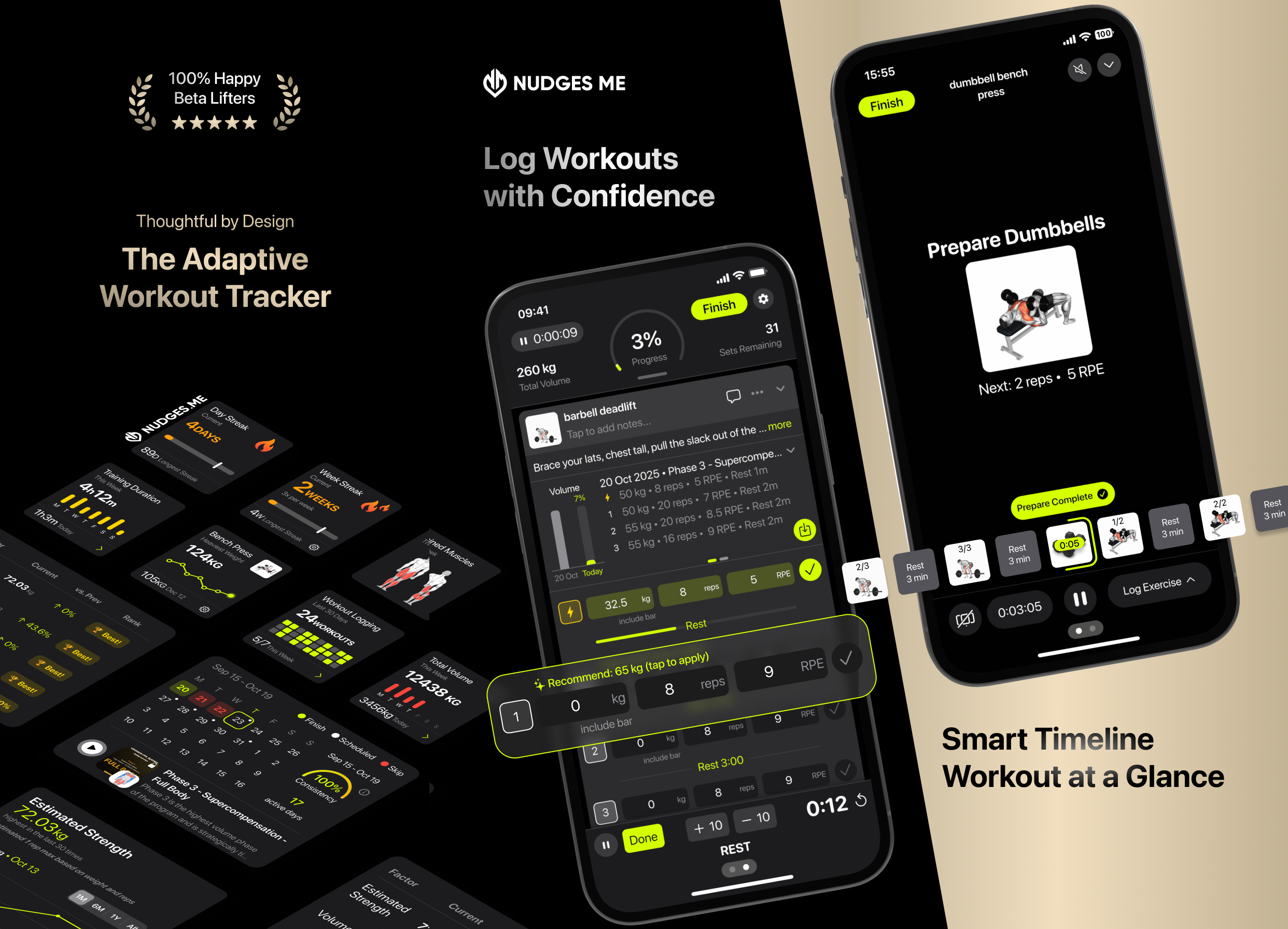
How to track workout splits with Nudges Me
Nudges Me supports workout splits by keeping training repeatable and measurable:
- Workout tracking - log exercises, sets, reps, and load without clutter
- Workout plans - follow a structured split so you stop improvising daily
- Progression tracking - see your performance improve over time on the lifts that matter
The goal is simple: fewer decisions, cleaner consistency, clearer progression.
FAQs
What is the best workout split?
The best workout split is the one you can follow consistently while progressing key lifts over time.
What workout split for beginners works best?
Most beginners do best with a 2 day or 3 day full-body split because it is simple, repeatable, and easy to track.
How many days per week should I lift?
Two to four days per week is enough for most late beginner to intermediate lifters. Five days can work if recovery is solid and volume is managed.
Is push pull legs split good for beginners?
It can be, especially as a 3-day rotation. Many beginners still progress fastest on full-body training because key lifts repeat more often.
Is an upper lower split better than full body?
Upper/lower is often better at 4 days per week. Full body is often better at 2-3 days per week. Match the split to your schedule.
How long should I run the same workout split?
Run a split for 6-10 weeks before making major changes, unless pain or scheduling issues force a change.
What if I miss a day on a split?
Do the next planned session when you can. Do not try to cram two full workouts into one day.
How do I know my split is working?
Your log should show gradual progress in load, reps, or set quality on your key lifts across weeks.
About the author
Trung Do
Related Articles
Continue reading with these related posts

Upper Lower Split
Upper/lower split alternates upper- and lower-body days. Choose 3, 4, or 6 days/week, get a sample routine, and track progression.
2-Day Workout Split
A complete 2 day workout split guide with examples, progression rules, and tracking tips so you stay consistent and keep getting stronger.

3-Day Workout Split
A 3 day workout split can build strength and muscle with consistent training. Learn the best options, examples, and how to progress safely.

4-Day Workout Split
A 4 day workout split balances training and recovery. See the best 4 day split options, a full example plan, and how to progress safely.

5-Day Workout Split
A practical 5 day workout split guide with examples, progression rules, and tracking tips to stay consistent and keep progressing.

Push Pull Legs Split
Learn the push pull legs split, who it fits, how to run it, and how to progress safely-plus a clean 3-6 day PPL example.