
Progressive Overload Explained: Gain Muscle & Strength

Quick Answer / TL;DR
- Best for: Lifters who want measurable strength and muscle progress without guessing
- Not ideal for: People who change exercises every workout and never track performance
- Core idea: Add reps, load, or sets gradually while keeping form and recovery stable
- How long to run: Track one plan for 6-10 weeks to see clear trends
Progressive overload is the practice of gradually increasing training stress over time so your body keeps adapting. It is for late beginner to intermediate and advanced lifters who want consistency and measurable progression instead of guessing what to do next. When you apply progressive overload with a repeatable plan and clean tracking, you can progress steadily without relying on hacks.
If you have been training for months but feel “stuck,” try tracking one lift for two weeks and apply one small overload change. The clarity is immediate.
Internal links:
What it is and why it works
Progressive overload is not a single method. It is a principle: training must become slightly more challenging over time to keep producing results.
Why it works:
- Your body adapts to repeated stress. If the stress stays the same, the adaptation slows down.
- Small increases compound. Adding a rep here, a little load there, or an extra set over weeks is how strength and muscle are built.
- It forces consistency. Overload only works when you repeat the same movements and track performance over time.
Progressive overload is what turns “working out” into “training.”
Internal links:
- how to structure a workout
- compound vs accessory lifts
Best for / Not ideal for
Best for
- Lifters following a plan and repeating key lifts weekly
- People who want strength and muscle growth with predictable progression
- Anyone tired of messy Notes, notebooks, or spreadsheets
- Lifters who want a simple progression rule that keeps them honest
Not ideal for
- People who change exercises every session and never repeat anything
- Lifters who train inconsistently and cannot follow a weekly structure
- Anyone returning from injury without clear constraints (needs individualized guidance)
- People who push every set to failure and cannot recover consistently
Internal links:
How it works in practice
Progressive overload can happen through several levers. The key is to change one lever at a time while keeping the rest stable enough to compare performance.
Common overload levers:
- Load: lift more weight for the same reps and sets
- Reps: do more reps at the same load
- Sets: add a set to increase weekly volume
- Density: do the same work in less time (shorter rest, same performance)
- Range of motion and technique quality: fuller ROM, stricter form at the same load
- Exercise difficulty: harder variation after you have earned it
Practical rules that keep it simple:
- Overload your main lifts first (your primary compound movements).
- Use accessories to add volume and target weak links without wrecking recovery.
- Repeat a plan long enough to see trends (usually 6-10 weeks).
Internal links:
Example progression framework
Here is a simple “double progression” framework that works for most lifters: use a rep range, add reps first, then add load.
Lift type | Target rep range | Progression rule | Example over 3 sessions |
|---|---|---|---|
Primary compound | 4-6 reps | When you hit the top end on all sets, add 2.5-5 lb | 4x4 → 4x5 → 4x6 (then add load) |
Secondary compound | 6-10 reps | Add reps across sets, then add load | 3x6 → 3x8 → 3x10 (then add load) |
Accessories | 10-15 reps | Add reps until you hit the top end, then small load increase | 3x10 → 3x12 → 3x15 (then add load) |
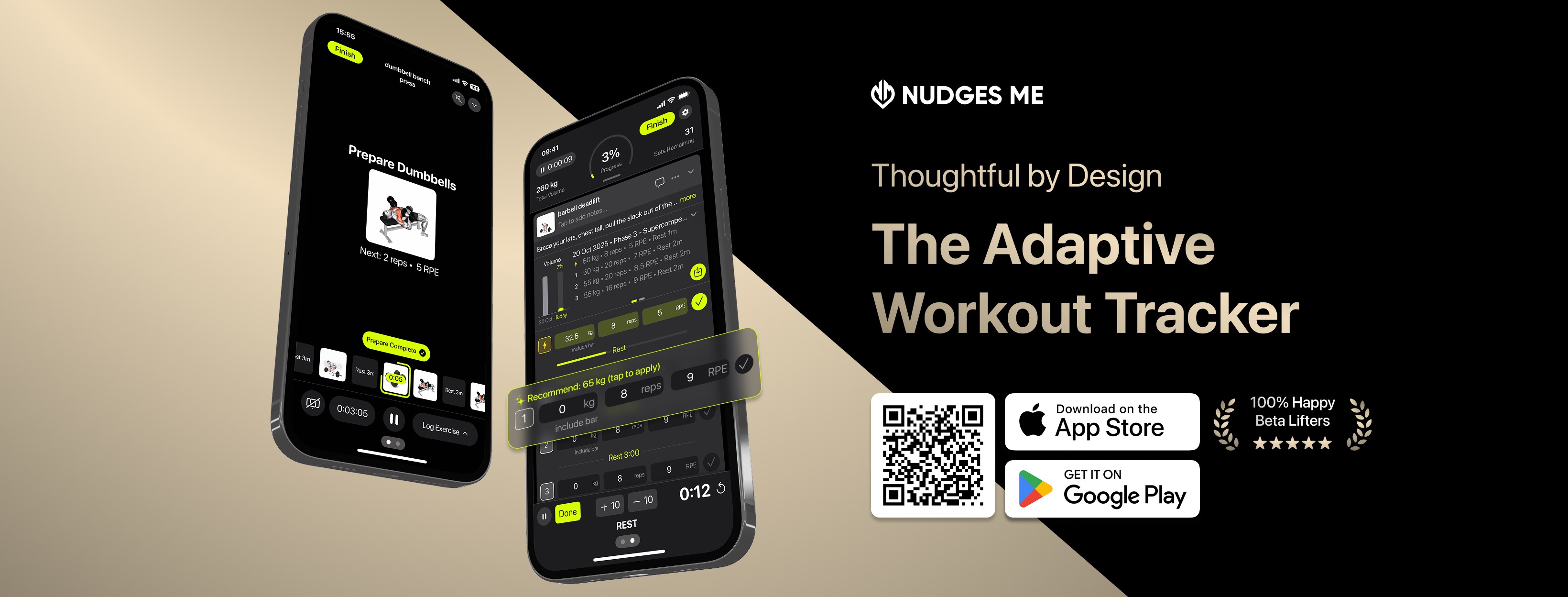
Track this progression framework cleanly with Nudges Me so each session shows you exactly what to beat next time.
Internal links:
How to progress safely
- Choose a repeatable plan before you chase overload.
Progressive overload needs consistency. Pick a split and keep the main lifts stable. - Set clear targets for each lift.
Use rep ranges and a simple rule like “add reps, then add load.” - Progress one variable at a time.
Do not add load, reps, sets, and reduce rest all in the same week. Pick one change and measure it. - Keep effort repeatable, not reckless.
Most sets should be challenging but controlled. Leaving 1-3 reps in reserve helps you recover and progress over time. - Treat plateaus as data, not failure.
If you stall for 2-3 exposures to the same lift, adjust one thing: - Reduce load slightly and rebuild
- Add a set to a supporting movement
- Reduce extra volume so your main lift can progress
- Track performance over time, not day to day mood.
Progressive overload is a trend. Your log should show gradual improvement across weeks.
Internal links:
- RPE and reps in reserve
- deload week guide
Common mistakes
Mistake | Why it’s a problem | Better approach |
|---|---|---|
Adding weight every session no matter what | Technique breaks down and recovery fails | Use rep ranges and add load only after you earn it |
Changing exercises too often | You cannot measure progression on moving targets | Keep main lifts stable for 6-10 weeks |
Chasing failure on most sets | Fatigue accumulates and progress stalls | Keep most sets controlled with reps in reserve |
Progressing everything at once | You cannot tell what caused progress or fatigue | Change one variable, track it, then decide |
Ignoring accessories completely | Weak links limit compounds and increase injury risk | Use accessories to build balance and volume |
Not tracking workouts consistently | You guess instead of progressing | Log each session and set a next time target |
How to track this with Nudges Me
Progressive overload works best when tracking is simple and consistent.
With Nudges Me, you can:
- Log workouts with exercises, sets, reps, and load
- Follow workout plans so your structure stays stable week to week
- See progression over time by comparing performance across sessions and weeks
That is the difference between “I think I’m improving” and knowing you are improving.
FAQs
- What is progressive overload in the gym?
It is gradually increasing training stress over time so your body keeps adapting. - Do I need to add weight every week?
No. You can progress by adding reps, sets, or improving performance quality before adding load. - Is progressive overload only for strength training?
No. The principle applies to any training where performance can be progressed, including bodyweight work. - How do I know if I am overloading too fast?
If form breaks down, soreness or fatigue never resolves, and performance drops across sessions, slow the progression. - What should I do when progress stalls?
Hold the load and add reps, reduce load slightly and rebuild, or adjust volume so you can recover and progress again.
Stop guessing what to do next. Replace messy notes and spreadsheets with Nudges Me, log every workout, follow a plan, and watch your progression over time become obvious.

About the author
Trung Do
Related Articles
Continue reading with these related posts

RPE/RIR for consistent training
Learn the RPE scale and RIR for lifting. Use RPE to stay consistent, manage effort, and progress week to week without guessing.

PR Meaning in Gym: Personal Records Explained
What does PR mean in the gym? Learn personal records, types of PRs, how to set them safely, and how to track PR progress over time.

How to structure a workout
Learn how to structure a workout with warm-ups, main lifts, accessories, and progression rules so you can train consistently and improve.