

How to structure a workout

Quick Answer / TL;DR
- Best for: Lifters who want a repeatable template that makes progression easier
- Not ideal for: People who pick random exercises each session
- Simple structure: Main lift(s) → secondary compound → accessories → optional finishers
- Goal: Keep the workout repeatable so you can progress sets, reps, and load over time
Structuring a workout is the process of organizing exercise order, sets, reps, and effort so your training stays consistent and progression is measurable over time. It is for lifters who want to stop improvising each session, especially if they currently rely on notebooks, Notes, or spreadsheets and still feel unsure what to do next. When your workouts follow the same structure week to week, progressive overload becomes easier because you can repeat the plan and beat small numbers consistently.
If your workouts feel random, try using a simple workout structure for one week and see how much easier it is to show up and execute.
Internal links:
What it is and why it works
A well-structured workout has three jobs:
- Prepare you to lift safely and perform well
- Prioritize what matters so your main lifts progress
- Add the right amount of volume without burying recovery
It works because it reduces chaos:
- You stop guessing what to do first.
- You know what is “main work” vs “extra work.”
- You can track the same movements and progress them over time.
Good structure is not complicated. It is repeatable.
Internal links:
Best for / Not ideal for
Best for
- Lifters who train 3-6 days per week and want a repeatable template
- Late beginners and intermediates who want consistent progress on main lifts
- People who waste time in the gym deciding what to do next
- Anyone who wants to track progression cleanly across weeks
Not ideal for
- People who do not want to repeat anything and treat training like random activity
- Lifters rehabbing injuries without guidance (needs individualized constraints)
- Anyone who adds so many exercises that the plan becomes impossible to follow
- Lifters who chase “hard” over “repeatable” every session
Internal links:
How it works in practice
Use this order for most strength and hypertrophy workouts:
- Warm-up and ramp sets
Prepare the joints and groove the movement pattern. Keep it short. - Primary lift (progression driver)
The lift you care most about progressing. Do it early when you are fresh. - Secondary compound lift
A related pattern that adds volume without competing too much with the primary lift. - Accessories
Hypertrophy and balance work. These build muscle and address weak links. - Optional finishers
Only if recovery allows. Keep them consistent or skip them.
A simple “workout recipe” that works
- 1 primary lift: 3-5 working sets
- 1 secondary lift: 2-4 working sets
- 2-4 accessories: 2-4 sets each
Choose reps based on the role:
- Primary lift: 3-8 reps
- Secondary lift: 5-12 reps
- Accessories: 8-20 reps
Effort guideline:
- Most working sets: about 1-3 reps in reserve
- Avoid turning every set into a grind
Internal links:
Example workout structure
Here is a sample upper body workout that follows the template and supports progression.
Section | Exercise | Sets x reps | Effort target | Why it is here |
|---|---|---|---|---|
Warm-up | Bench ramp sets | 3-5 ramp sets | Easy to moderate | Prepare and groove technique |
Primary lift | Barbell Bench Press | 4 x 5 | 1-2 reps in reserve | Main progression driver |
Secondary lift | Chest Supported Row | 4 x 8 | 2 reps in reserve | Balance pressing, add back volume |
Accessory | Incline DB Press | 3 x 10 | 2 reps in reserve | Upper chest and extra pressing volume |
Accessory | Lateral Raise | 3 x 15 | 2-3 reps in reserve | Shoulders, low joint cost |
Accessory | Triceps Pressdown | 3 x 12 | 2 reps in reserve | Direct arm work that supports pressing |
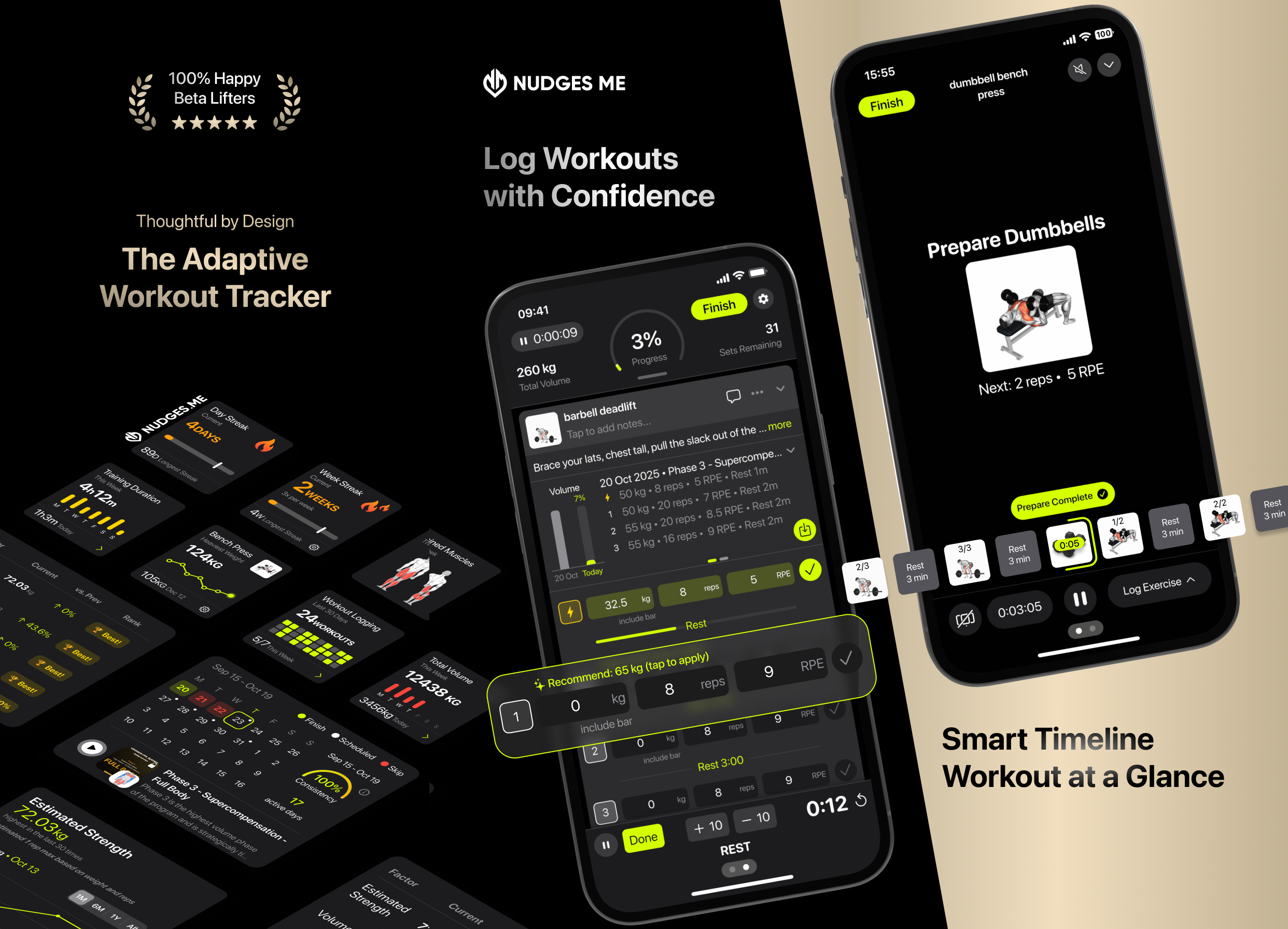
If you want your workouts to feel this clear every time, follow a structured plan in Nudges Me and log each session so progression is easy to spot.

How to progress safely
- Choose one lift per workout to prioritize.
That lift gets first position and the clearest progression rule. - Use rep ranges instead of fixed numbers for most lifts.
Example: bench 4 sets of 4-6. When you hit 6 on all sets, add 2.5-5 lb. - Progress one variable at a time.
Progressive overload stays clean when you choose one: - Add reps at the same load
- Add load at the same reps
- Add a set only if recovery is strong
- Keep accessories supportive, not exhausting.
Accessories should build volume without ruining the next session. If you are always sore and your main lift stalls, reduce accessory sets first. - Track performance over time and adjust with evidence.
Look at 3-6 weeks of logs. If your loads or reps trend up at similar effort, your structure is working.
Internal links:
Common mistakes
Mistake | Why it’s a problem | Better approach |
|---|---|---|
Starting with random accessories | You fatigue the muscles you need for the main lift | Put primary compound lift first |
No clear progression rule | You repeat workouts without improving them | Use rep ranges and planned load jumps |
Too many exercises | Time and recovery blow up, sessions get skipped | Keep 4-7 total exercises per workout |
Grinding every set | Fatigue accumulates and form breaks down | Keep most sets repeatable with reps in reserve |
Changing the workout every session | You cannot compare performance or progress | Repeat the template for 6-10 weeks |
Tracking inconsistently | You lose the ability to spot trends | Log every working set for main lifts |
Internal links:
How to track this with Nudges Me
A good workout structure only pays off if you can repeat it and see what changed.
With Nudges Me, you can:
- Log workouts with exercises, sets, reps, and load
- Follow workout plans so your workout order stays consistent
- See progression over time by comparing sessions week to week
This is how you replace messy notes with a clean training system.
FAQs
- What comes first in a workout?
Usually your primary compound lift, after a short warm-up and ramp sets. - How many exercises should a workout have?
Most lifters do well with 4-7 exercises total: 1 primary, 1 secondary, and 2-4 accessories. - How long should a workout be?
Often 45-75 minutes depending on rest times and how many exercises you do. - Should I train to failure?
Not most of the time. Keeping 1-3 reps in reserve helps you recover and progress consistently. - How do I know if my workout structure is working?
If your main lift loads or reps trend upward over weeks at similar effort, the structure is working.
If your workout structure lives in scattered notebooks, Notes, or spreadsheets, you will keep repeating sessions without clear progression. Stop guessing - follow a plan in Nudges Me, log every workout, and see progression over time in one clean place.

About the author
Trung Do
Related Articles
Continue reading with these related posts

Upper Lower Split
Upper/lower split alternates upper- and lower-body days. Choose 3, 4, or 6 days/week, get a sample routine, and track progression.

Push Pull Legs Split
Learn the push pull legs split, who it fits, how to run it, and how to progress safely-plus a clean 3-6 day PPL example.

3-Day Workout Split
A 3 day workout split can build strength and muscle with consistent training. Learn the best options, examples, and how to progress safely.

4-Day Workout Split
A 4 day workout split balances training and recovery. See the best 4 day split options, a full example plan, and how to progress safely.

5x5 Workout Program: Complete Guide for Strength Progression
The 5x5 program builds strength with repeated compound lifts. Learn how it works, a full 5x5 example plan, and how to progress safely.