

Supersets: What They Are and How to Use Them

Quick Answer / TL;DR
A superset is performing two exercises back to back with minimal rest, usually to save time or increase training density.
- Best for: Busy lifters, accessory work, conditioning-focused sessions
- Not ideal for: Heavy compounds where performance and technique matter most
- Rule: Superset accessories more often than main lifts
A superset is a training method where you perform two exercises back to back with little to no rest between them. It is for lifters who want a simple way to save time, increase training density, and stay consistent without changing their whole plan. When supersets are programmed well and tracked over time, they can support progression by keeping effort honest and making workouts easier to repeat.
If you are short on time, try one superset pair this week and see how much smoother your workout flow feels when it is planned.
What it is and why it works
A superset is not a magic technique. It is a structure: two exercises paired together, repeated for multiple rounds.
It works best for three reasons:
- Time efficiency: you get more done in less time.
- Training density: you do similar work with less idle rest.
- Consistency: pre-planned pairings reduce decision fatigue and make sessions repeatable.
Supersets are most effective when they do not sabotage the performance of your main lifts. That is why many lifters use them for accessories, not for their heaviest compound sets.
Best for / Not ideal for
Best for
- Lifters who want shorter sessions without skipping key work
- Accessory work that does not require long rest intervals
- Hypertrophy-focused training where moderate loads and consistent reps matter
- People who struggle to finish workouts because they drag between sets
Not ideal for
- Heavy compound training where performance depends on full rest
- Exercises that become unsafe when fatigued (technical barbell lifts for many lifters)
- People who turn every workout into a nonstop circuit and lose progression
- Anyone whose superset choices create major equipment bottlenecks at a busy gym
How it works in practice
The basic structure
A superset is usually written as A1 and A2:
- A1: Exercise 1
- Minimal rest (0-30 seconds)
- A2: Exercise 2
- Rest 60-120 seconds
- Repeat for the planned number of rounds
Example:
- A1 Incline DB Press x 10
- A2 Chest Supported Row x 10
- Rest 90 seconds
- Repeat 3 rounds
Types of supersets you will actually use
- Opposing muscle groups (push-pull)
Good for performance and joint balance.
Example: press + row. - Same muscle group (compound + isolation)
Good for hypertrophy, more fatigue.
Example: lat pulldown + curls, leg press + leg extension. - Upper + lower pairing
Good for saving time, but manage breathing and fatigue.
Example: row + calf raise. - Non-competing accessories
Often the easiest to recover from.
Example: lateral raise + leg curl.
Superset rules that keep your training productive
- Keep your main lift mostly straight sets if strength progression matters.
- Superset accessories first, then progress load or reps like normal.
- Use effort targets that stay repeatable, like 1-3 reps in reserve on most sets.
Example superset workouts
Below are plug-and-play examples you can add to an upper body day without changing your main lift.
Goal | Superset pair | Sets x reps | Rest guidance |
|---|---|---|---|
Balanced upper accessories | A1 Incline DB Press + A2 Chest Supported Row | 3 x 8-12 each | Rest 60-120 sec after A2 |
Shoulder and arm volume | A1 Lateral Raise + A2 Cable Triceps Pressdown | 3 x 12-20 and 10-15 | Rest 45-90 sec after A2 |
Back and biceps | A1 Lat Pulldown + A2 DB Curl | 3 x 8-12 and 8-15 | Rest 60-120 sec after A2 |
Legs finishers | A1 Leg Curl + A2 Calf Raise | 3 x 10-15 and 8-15 | Rest 60-90 sec after A2 |
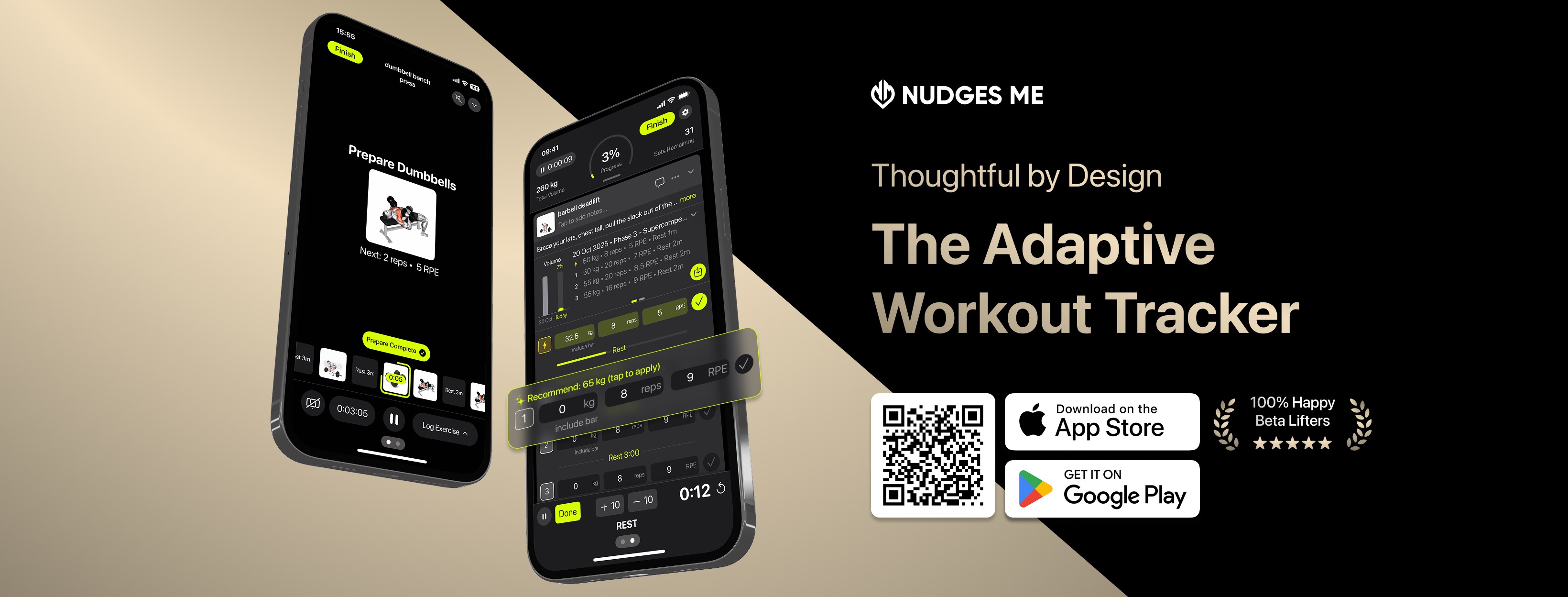
Supersets only work if you repeat them. Track the pairing, sets, reps, and load in Nudges Me so you can progress the same superset week to week.
How to progress safely
- Choose the right pairing before adding intensity.
Start with non-competing or push-pull pairings so your reps stay consistent. - Set a clear progression rule.
Use progressive overload like you would with straight sets: - Add reps within a rep range, then add load.
- Or hold reps steady and add small load jumps.
- Keep effort repeatable.
Most accessory supersets should stay around 1-3 reps in reserve. If every set turns into a grind, you will stall or lose form. - Progress one variable at a time.
Do not increase load, reps, and reduce rest all at once. Pick one: - More reps at the same load and rest
- More load at the same reps and rest
- Slightly less rest while holding performance steady
- Track performance over time.
The goal is not to feel destroyed. The goal is to see your numbers move in the right direction across weeks.
Common mistakes
Mistake | Why it’s a problem | Better approach |
|---|---|---|
Super-setting heavy compounds by default | Reduces performance and can increase technique breakdown | Keep main lifts as straight sets, superset accessories |
Pairing exercises that compete too much | Fatigue kills reps and load, progression becomes unclear | Use push-pull or non-competing pairings |
No standard rest rules | You cannot compare performance week to week | Use simple rest targets after A2 and keep them consistent |
Treating supersets like cardio circuits | Effort becomes chaotic, strength and hypertrophy progress suffers | Keep reps controlled and stop with 1-3 reps in reserve |
Hogging equipment in a busy gym | Creates friction and you skip the plan | Choose pairs that are realistic in your gym setup |
Not tracking the pairing | You forget what you did and cannot progress it | Log A1 and A2 together and repeat the structure |
How to track this with Nudges Me
Supersets are simple when the structure is clear and repeatable.
With Nudges Me, you can:
- Log workouts with the exact two-exercise pairing, sets, reps, and load
- Follow workout plans that include pre-built superset pairings
- See progression over time by comparing how the same superset performs week to week
This is how supersets become a progression tool instead of a one-off burnout technique.
FAQs (5)
- What is a superset?
A superset is two exercises performed back to back with minimal rest, repeated for rounds. - Are supersets good for building muscle?
They can be, especially for accessories, because they increase training density while keeping volume high. - Should I superset my main lifts like squat and bench?
Usually no. Most lifters progress better with full rest on heavy compounds. - How much rest should I take in a superset?
Typically minimal rest between exercises, then 60-120 seconds after the second exercise, adjusted to maintain reps and form. - Do supersets replace progressive overload?
No. Supersets are a structure. You still need to progress reps or load over time.
If your superset pairs are scribbled in notebooks or scattered across Notes and spreadsheets, you will repeat workouts without real progression. Stop guessing - log your supersets in Nudges Me, follow a plan, and see your performance improve over time with clean tracking.

About the author
Trung Do
Related Articles
Continue reading with these related posts

RPE/RIR for consistent training
Learn the RPE scale and RIR for lifting. Use RPE to stay consistent, manage effort, and progress week to week without guessing.

PR Meaning in Gym: Personal Records Explained
What does PR mean in the gym? Learn personal records, types of PRs, how to set them safely, and how to track PR progress over time.
How to Log Sets and Reps for Real Progress
Learn how to log sets and reps the right way, what to write down, and how to use your logs for consistent training and progression.