
PR Meaning in Gym: Personal Records Explained

Quick Answer / TL;DR
- PR meaning in gym: A personal record - your best performance on a lift or workout metric
- Best for: Lifters who want motivation and clear progression targets
- Not ideal for: People who chase PRs constantly and ignore recovery
- How to use: Track PRs on key lifts and aim for small improvements over time
PR is a personal record - your best performance on a lift or workout for a given standard, like the most weight for a certain number of reps. It is for lifters who want a clear way to measure progress while staying consistent with a plan instead of chasing random “best days.” When you define PRs properly and track them over time, they become a practical tool for progression and smarter progressive overload.
Curious what you are actually improving? Log a few key lifts and see your PRs emerge over time in Nudges Me.
What it is and why it works
In the gym, PR means personal record. It is not only a one-rep max. A PR can be any repeatable “best” that you can compare over time.
PRs work because they:
- Create clarity: you know what “better” means
- Reward consistency: small improvements count when tracked
- Support progression: they help you apply progressive overload with intention
- Reduce guesswork: you stop relying on memory or vibes
The key is to define PRs with the same rules each time so comparisons stay honest.
Best for / Not ideal for
Best for
- Lifters who want measurable progress without changing programs constantly
- Late beginners building baseline strength and consistency
- Intermediate lifters tracking multiple rep ranges (3s, 5s, 8s, 10s)
- Anyone who trains with a plan and wants proof the plan is working
Not ideal for
- People who chase PRs every session and sacrifice technique
- Lifters with inconsistent schedules who cannot repeat conditions at all
- Anyone using PRs as motivation only, not as feedback for programming
- Lifters returning from injury who need stable rehab loads first
How it works in practice
The most useful types of PRs
Most lifters benefit from tracking PRs in more than one format:
- 1RM PR: heaviest single with good form
- Rep PR: most weight for a given reps target (example: best 5-rep set)
- Volume PR: best total work in a session (example: 5x5 at 225)
- Time or density PR: same work in less time or more work in same time (more common in conditioning, but can apply to accessories)
What makes a PR valid
A PR should be comparable. That means you keep standards consistent:
- Same exercise variation (high bar squat vs low bar squat are different)
- Similar technique rules (depth, pause, touch-and-go, straps or no straps)
- Same rep target and set context when possible (top set vs back-off)
- Similar effort guideline (example: rep PRs that are not true grinders)
You do not need perfect lab conditions. You just need consistent rules.
Example framework for PRs
Use a simple framework that keeps PRs meaningful and repeatable.
PR types you can track for each main lift
PR type | Definition | Example | When to use |
|---|---|---|---|
1RM PR | Best single with clean form | Bench 225 x 1 | Occasional testing block |
3RM or 5RM PR | Best weight for that rep count | Squat 275 x 5 | Strength and hypertrophy phases |
8RM to 12RM PR | Best weight for higher reps | RDL 185 x 10 | Hypertrophy and accessories |
Volume PR | Best session volume under a set structure | 5x5 at 185 | When your plan repeats weekly |
Example: a “PR-friendly” week structure
Day | Main lift goal | PR standard | What you track |
|---|---|---|---|
Day 1 | Heavy top set | Best 3 reps at clean form | Load, reps, RPE or RIR note |
Day 2 | Volume work | Best 5x5 weight | Load per set, completed sets |
Day 3 | Hypertrophy | Best 8 reps | Load, reps, range of motion |
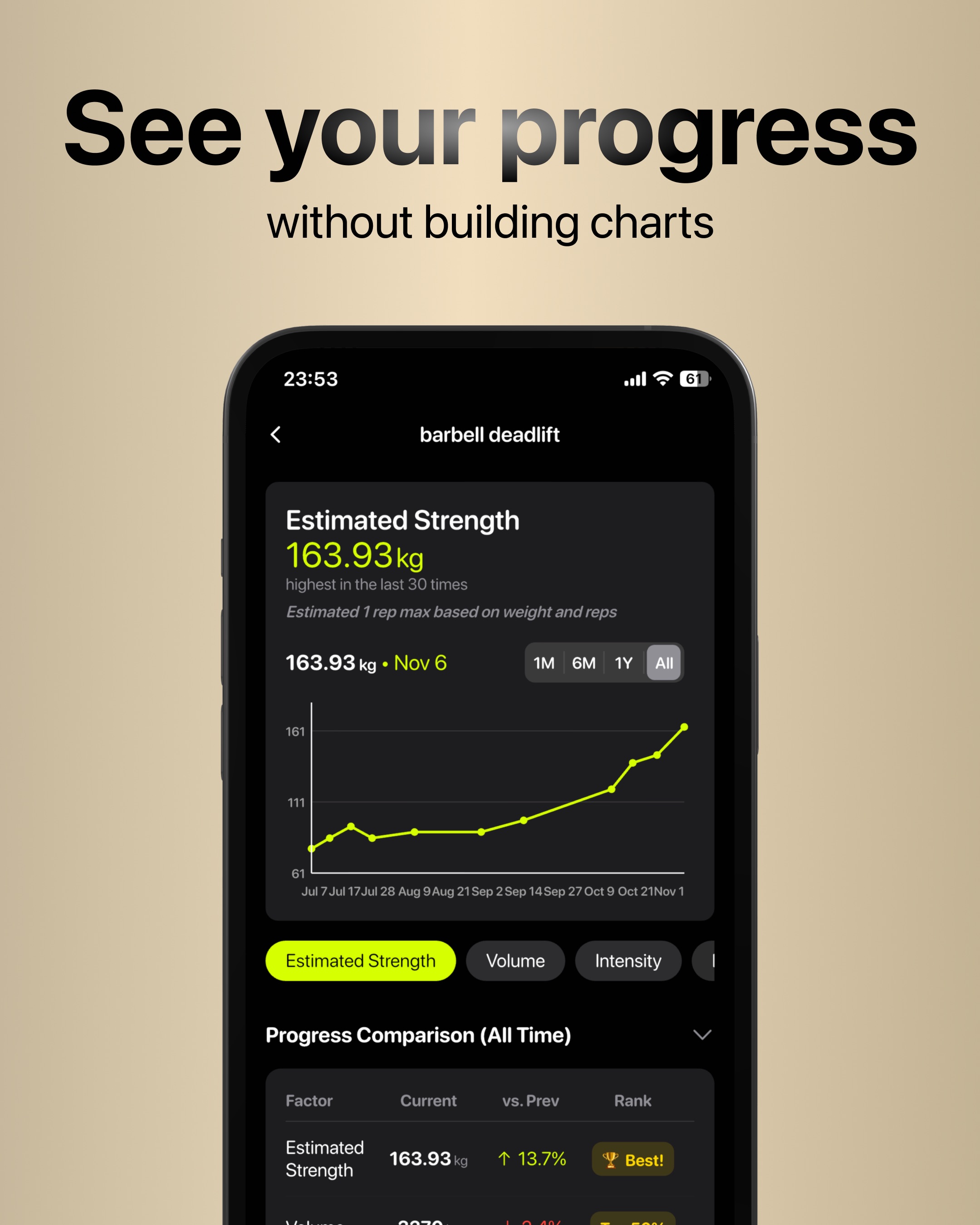
PRs only matter if you can find them later. Log your workouts and follow a consistent plan in Nudges Me so your best sets are not buried in notes.
How to progress safely
- Pick the PR types you will track.
Start with 1-2 per main lift, such as a 5RM PR and a volume PR. Too many PR categories creates noise. - Use progressive overload, not constant testing.
Most progress comes from repeatable training. Use overload rules: - Add reps at the same load
- Add small load jumps at the same reps
- Add sets only when you can recover
- Separate “training PRs” from “testing PRs.”
Training PRs can happen inside normal work sets, like a best set of 5 at a given effort. Testing PRs, like true 1RM attempts, should be planned and rare. - Protect technique standards.
A PR that comes from cut depth, bouncing reps, or losing position is not a useful data point. Your standard should be the same each time. - Track performance over time and adjust.
If your rep PRs improve while your 1RM stays flat, you may be building capacity. If everything stalls, you may need changes in volume, intensity, or recovery.
Common mistakes
Mistake | Why it’s a problem | Better approach |
|---|---|---|
Treating PR as only a one-rep max | Misses most of the progress you can actually repeat | Track rep PRs and volume PRs too |
Chasing PRs every session | Fatigue accumulates, form breaks down, progress stalls | Build PRs inside planned training blocks |
Changing variations constantly | PR comparisons become meaningless | Keep main lift variations stable 6-10 weeks |
No clear standards for form | You cannot compare effort or range of motion | Define technique rules and stick to them |
Only tracking “best days” | You lose the trend line that drives progression | Track every session, not just highlights |
Using memory instead of data | You overestimate or underestimate progress | Log sets, reps, and loads consistently |
How to track this with Nudges Me
Tracking PRs is simple when your workouts are logged consistently.
With Nudges Me, you can:
- Log workouts with sets, reps, and load so your best performances are recorded
- Follow workout plans so your PRs come from repeatable standards, not random sessions
- See progression over time by comparing previous sessions and noticing when a rep PR or volume PR improves
The goal is not constant testing. The goal is clean tracking that makes progression obvious.
FAQs (5)
- What does PR mean in the gym?
PR means personal record - your best performance for a specific lift or standard. - Is a PR only a one-rep max?
No. Rep PRs and volume PRs are often more useful for consistent progression. - How often should I try to hit a PR?
Let PRs happen inside your plan. True max testing should be occasional and planned. - What is a rep PR?
A rep PR is the most weight you have lifted for a specific number of reps, like your best 5 reps on squat. - How do I know if a PR counts?
If it meets your standards for form and the rep target, and it is comparable to previous attempts, it counts.
If your PR history lives in scattered notebooks, Notes app entries, or spreadsheets, you will miss patterns that drive real progression. Log every session in Nudges Me, follow your plan, and see your PRs and progress build over time without the mess.
About the author
Trung Do
Related Articles
Continue reading with these related posts